Enterprise AI Governance: How to Secure LLM Usage Without Slowing Down Innovation
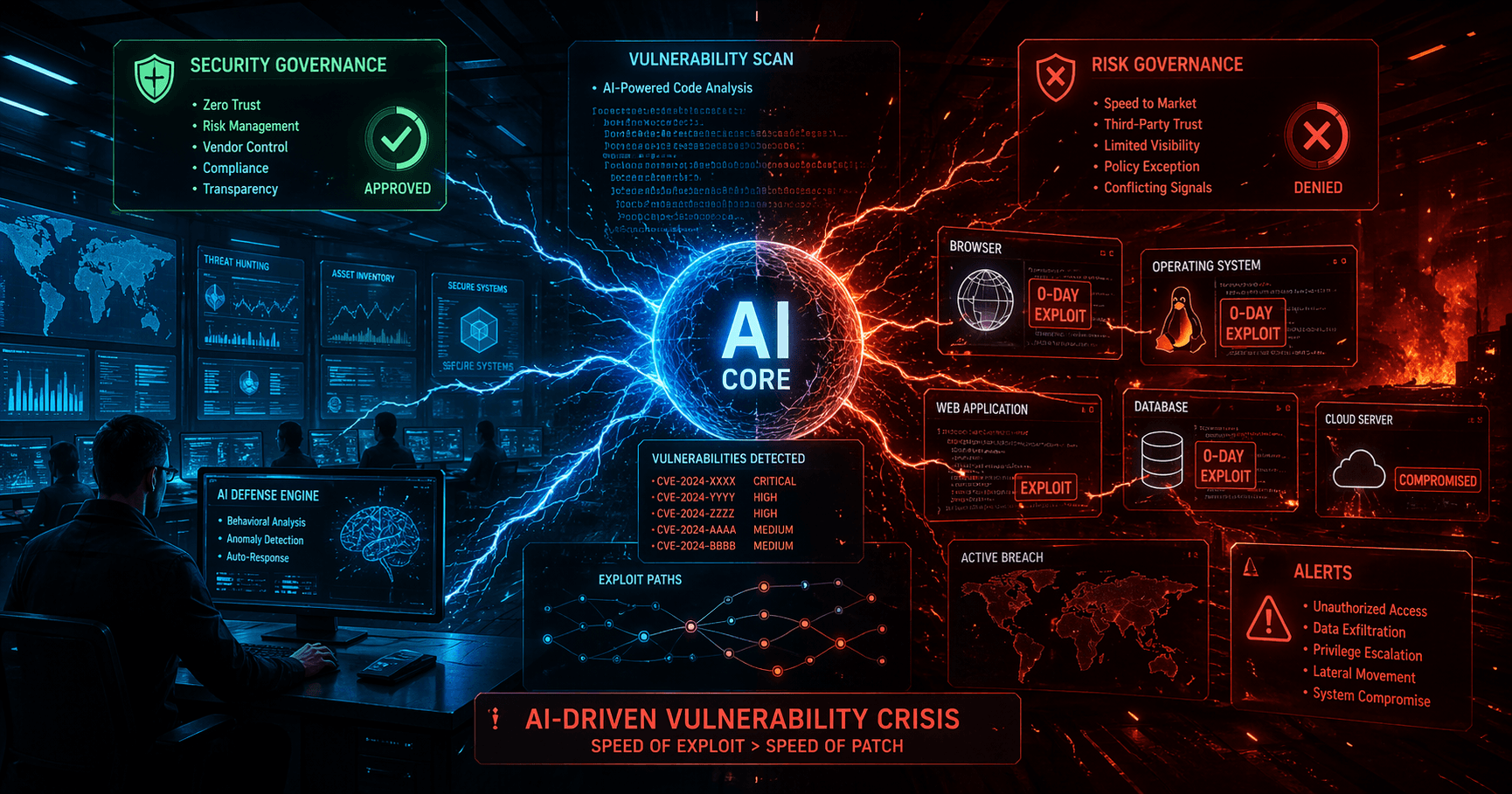
Teams are already using LLMs in production. Not in pilots: in daily work, across coding agents, document drafters, customer support tools, and model APIs that sit entirely outside the corporate security perimeter. Most of this happened before governance did.
The security problem is not that LLMs exist. It is that sensitive data, business logic, and privileged actions now move through systems the enterprise did not design, did not approve, and often cannot see. Employees paste contracts, source code, and credentials into chat interfaces because the friction is low and the risk feels invisible. Coding agents connect to repositories with access scopes broader than any junior engineer would be granted. And when something goes wrong, the organization frequently cannot answer the simplest post-incident question: who sent what to which model, and what happened next?
This post covers what enforceable enterprise AI governance actually looks like, where the meaningful failure points are, and which controls separate a managed program from unmanaged sprawl.
Why Policy Alone Fails
The governance problem with LLMs is not a writing problem. Most organizations already have acceptable-use policies. The failure is that those policies have no enforcement surface.
A policy document can describe intent. It cannot inspect a prompt for PII before it leaves the network. It cannot prevent a developer from connecting a personal API key to a production codebase. It cannot answer an auditor asking which models processed regulated data last quarter.
Effective governance requires enforcement points: identity systems, routing layers, content inspection pipelines, and logging infrastructure that shape what employees and agents are actually allowed to do. The policy is the specification; the gateway, the IAM integration, and the log pipeline are the implementation. Without both, governance is aspirational.
The Five Failure Modes
The source material maps five distinct risk categories. Each has different ownership and different remediation logic.
1. Prompt-level data leakage Employees send sensitive content because the interface feels casual. Meeting notes, source code, acquisition targets, legal drafts, customer records. The content leaves the enterprise network, gets processed externally, may be retained in vendor logs, and is potentially exposed in future model outputs. This is the most common and the hardest to prevent through training alone.
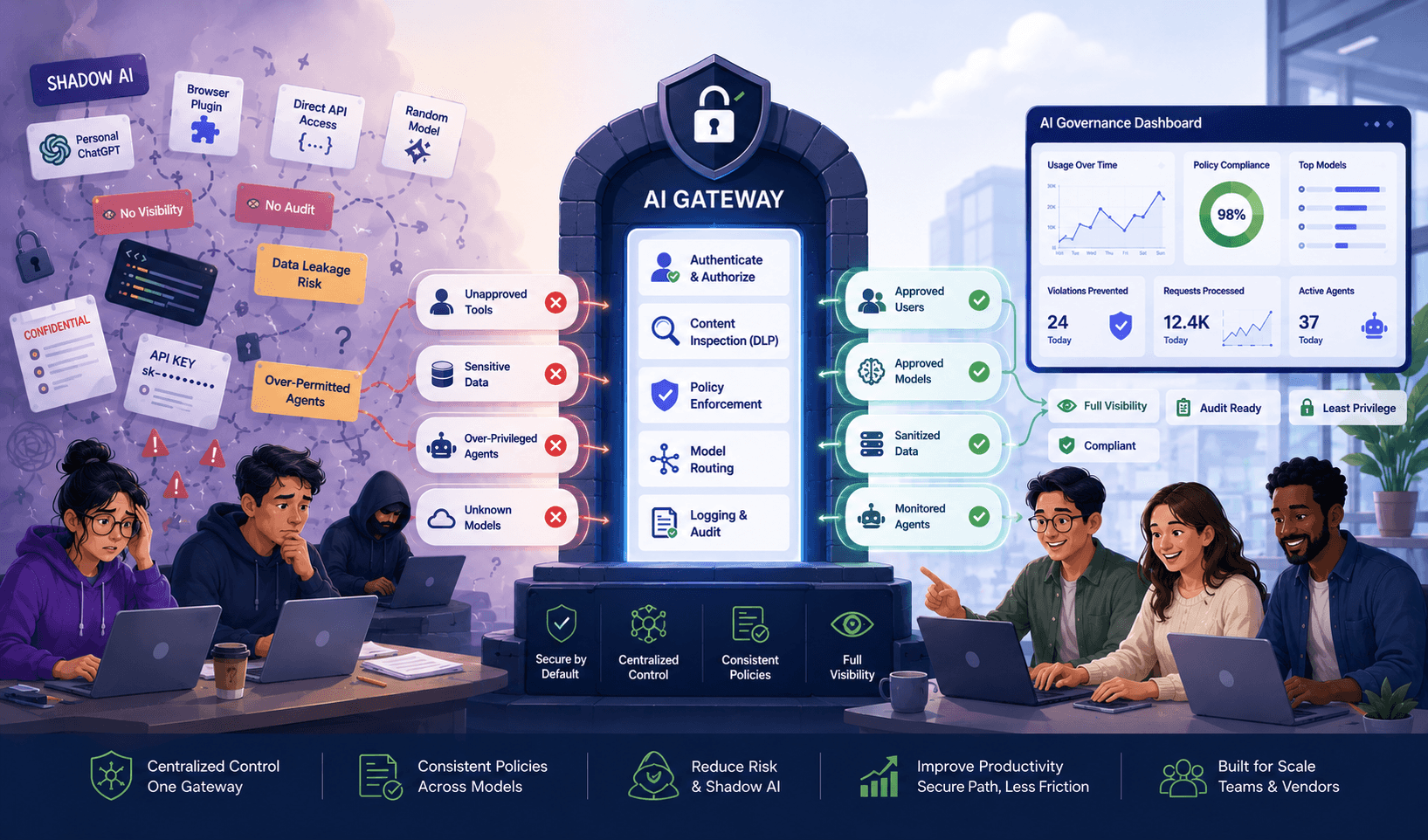
2. Shadow AI Teams adopt browser plugins, personal accounts, unsanctioned coding assistants, and direct model APIs because approved tools are slower or unavailable. The enterprise loses visibility into data flows, cannot control costs, and cannot produce audit evidence. Shadow AI is a symptom of governance friction: if the approved path is harder than the unapproved one, engineers will route around it.
3. Over-privileged agentic automation LLM-based agents that connect to repositories, ticketing systems, cloud platforms, and local development environments often receive broad access because scoping is an afterthought. An agent operating with enterprise-wide tool access is a probabilistic system making decisions with production-level privileges. That is not inherently unacceptable, but it requires the same access controls applied to any privileged service account: narrow scope, explicit approval, logged invocations, and easy revocation.
4. Audit gaps AI logging is not the same as application telemetry. A useful AI audit record needs to capture: which identity made the request, which model processed it, what tools were invoked, what policy checks ran, and whether the request triggered a violation. Organizations that log only API call counts or response codes cannot answer incident questions, cannot demonstrate compliance, and cannot detect misuse patterns.
5. Fragmented vendor controls Direct integrations with multiple LLM providers expose the enterprise to inconsistent retention settings, regional data residency defaults, moderation behaviors, and audit features. Without a common control plane, each new model or vendor introduces its own governance exceptions.
MITRE ATT&CK Relevance
This is not a traditional attack-technique article. The risks here are primarily insider and misconfiguration scenarios rather than external adversarial kill chains. That said, the failure modes map directly to documented technique categories:
| Technique ID | Name | LLM Governance Context |
|---|---|---|
| T1530 | Data from Cloud Storage | Coding agents with broad repo/storage access exfiltrate or expose sensitive content without explicit transfer |
| T1078 | Valid Accounts | Shadow AI usage via personal accounts bypasses enterprise monitoring; agent credentials used outside approved scope |
| T1567 | Exfiltration Over Web Service | Sensitive prompt content transmitted to external model endpoints outside DLP perimeter |
| T1562.001 | Disable or Modify Tools | Users or agents bypassing content inspection, logging, or policy enforcement layers |
The techniques above describe what happens when governance fails, not active attacker behavior. In most enterprises, the threat actor is an uninformed insider, not an adversary. That matters for control design: detection logic and prevention controls need to cover accidental misuse as much as deliberate abuse.
What Security Professionals Should Build
Platform and Security Engineering: The AI Gateway
The AI gateway is the most impactful single control an enterprise can implement. It routes all LLM traffic through a central layer before it reaches any model provider, creating one place where authentication, model routing, content inspection, logging, cost controls, and policy enforcement can be applied consistently.
Without a gateway, every team that adopts a new model or vendor also adopts a new governance exception. With a gateway, adding a new approved model means updating routing config, not rewriting controls.
A baseline-capable gateway enforces:
| Control | What it does |
|---|---|
| Identity binding | Every request is attributed to a named user, service account, or workload identity |
| Authorization | Role-based access to models, data domains, and connected tools |
| Content inspection | Secrets, PII, and regulated data detected and blocked or redacted before transmission |
| Structured logging | User, model, tool invocations, policy decisions, and timing captured per request |
| Model routing | Traffic directed to approved models based on sensitivity tier, geography, or business policy |
| Cost and quota controls | Per-team budgets and rate limits applied centrally |
Not every organization needs all of these on day one. But the gateway needs to exist before governance becomes impossible to retrofit.
GRC: Classification Before Deployment
The governance failure in most enterprises is not that rules are missing; it is that use cases are deployed before anyone decides which data classification applies. A summarization use case on public marketing content and a contract review use case on customer agreements should not share the same model, the same prompt path, or the same audit requirements.
GRC's job here is to define use-case tiers before models go into production. Each tier specifies: which models are approved, whether a gateway is required, what redaction must happen, and whether human review is needed before outputs are trusted or acted on. That classification work also becomes the primary evidence artifact for audits under EU AI Act obligations and NIST AI RMF documentation requirements.
AppSec: Coding Agent Guardrails
Coding agents warrant specific attention because they sit adjacent to repositories, terminals, configuration files, and deployment workflows. They can read files, propose or write code, inspect secrets, and in some configurations execute shell commands. The access profile looks like a privileged developer, but the decision-making model is probabilistic and hard to predict under novel inputs.
Before deploying a coding agent in an enterprise environment, AppSec and platform teams should define:
- Which repository scope the agent can access (sandbox vs. production vs. specific directories)
- Whether the agent can read secrets or environment files, and under what conditions
- Whether prompts and outputs are retained, and by which party
- Whether the model provider uses submitted content for training (most enterprise contracts exclude this, but it requires verification)
- Which user groups can access autonomous vs. supervised modes
The practical failure mode is not that coding agents are inherently unsafe. It is that the defaults are permissive and the scoping conversation rarely happens before deployment.
SOC: What Visibility Actually Looks Like
SOC visibility into LLM misuse is limited in most environments unless a gateway or proxy is in place. Without one, the SOC sees outbound HTTPS to api.openai.com or similar endpoints, volume anomalies at best, and nothing about prompt content.
Where a gateway is deployed and logs are integrated with the SIEM, the signals worth tuning for include: requests from unexpected identities or service accounts, prompt content that matches DLP signatures for secrets or regulated data, unusually large context payloads, tool invocations outside the expected set, and cost spikes inconsistent with team usage patterns.
Shadow AI is harder. The most reliable detection approach is DNS or proxy-level monitoring for known model API endpoints, combined with EDR telemetry showing browser extensions or local CLI tools communicating with external model endpoints. Blocking at the egress layer for unapproved model endpoints is a blunt but effective starting point while the approved gateway path matures.
Key Takeaways
-
When deploying any LLM use case, classify the data sensitivity first. The model selection, gateway requirement, redaction pipeline, and human review gate all flow from that classification. Deploying without it means controls are always retroactive.
-
When a coding agent needs access to a system, apply the same scoping logic as a service account. Narrow to the minimum required path, log every tool invocation, and revoke on session end. Broad agent access is not a productivity feature; it is a risk surface.
-
When an AI tool request arrives outside the approved gateway path, treat it as shadow IT, not a tooling preference. The governance question is not whether the tool is good; it is whether the enterprise can see it, control it, and explain it to an auditor.
-
When logging AI usage, capture identity, model, tools invoked, and policy decisions per request. Volume metrics and response codes are insufficient for post-incident investigation or compliance evidence.
-
When a vendor's data retention, region, or moderation defaults differ from enterprise policy, that is a gap, not an exception. The gap requires either a contractual amendment, a technical compensating control, or a decision not to use that vendor for that use case.
The underlying pattern across all five failure modes is the same: governance without an enforcement surface is documentation, not control. The organizations that manage AI adoption well are not the ones with the most comprehensive policies. They are the ones that built a governed path that is easier to use than the ungoverned alternative.
Practice on MyKareer
GRC practitioners are increasingly expected to evaluate AI governance frameworks, define acceptable use policies, and produce compliance evidence for AI-related audits. If you want to sharpen your ability to reason through governance design, risk classification, and control frameworks under interview pressure, the GRC practice path on MyKareer covers the decision-making scenarios that come up in those conversations.