Why Tool Lists Fail in Pentest Interviews (and What to Say Instead)
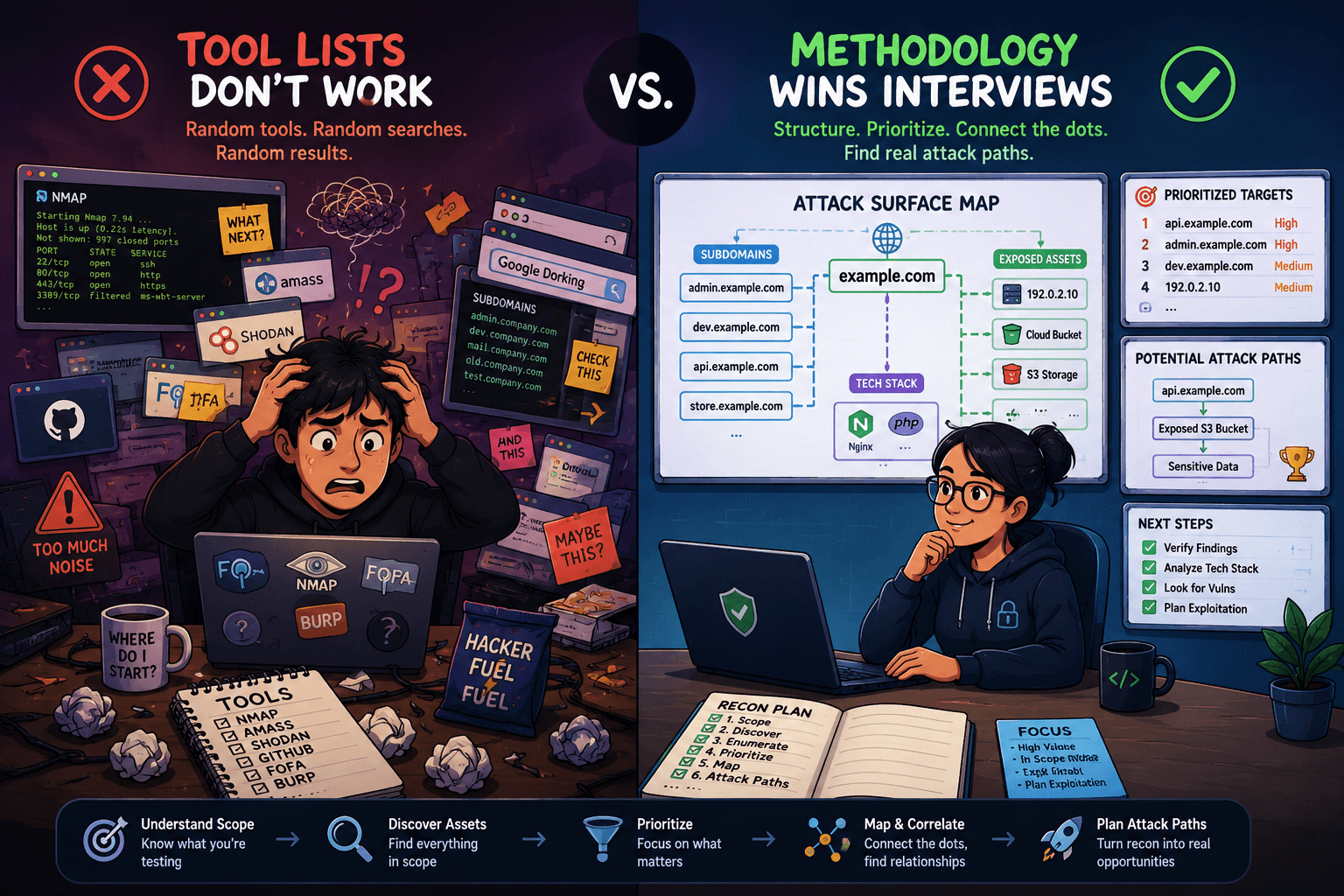
Before an external pentest begins, the client gives you only a company name and primary domain and leaves you one week for reconnaissance. A weak answer starts with Nmap and a shopping list of tools. A strong answer maps the attack surface systematically, prioritizes what will matter during testing, and explains how each OSINT lead could turn into an attack path.
The Common Mistake
Pentest candidates often confuse activity with methodology.
"I would run Nmap, use Amass to find subdomains, search Shodan, look in GitHub, and then start testing anything interesting."
That answer sounds busy, but it is thin where interviewers care. The candidate is naming tools without explaining order, scope discipline, or what counts as useful reconnaissance. External recon is not a scavenger hunt. The point is not to collect the largest possible pile of artifacts. The point is to build an attack-surface picture that improves the technical phase of the engagement.
The weak answer also skips translation. Finding a subdomain matters only if the candidate can explain whether it is likely in scope, whether it points to a cloud footprint, whether it suggests a forgotten environment, or whether it supports credential, phishing, or application testing later. The same gap appears with employee OSINT. Mentioning LinkedIn is easy. Explaining how job postings, titles, and security tooling references affect social-engineering or detection assumptions is harder. That is exactly the gap interviewers are probing.
What Interviewers Are Testing For
This question is really about structured reconnaissance. Strong candidates show that they can collect information selectively, keep it tied to attack hypotheses, and avoid random searching.
The patterns interviewers usually expect are:
- Systematic mapping of domains, IP space, cloud assets, and public-facing services rather than ad hoc searching.
- Prioritization of findings that directly inform technical testing, such as exposed apps, leaked credentials, or technology fingerprints.
- Use of employee and organizational OSINT only when it can support a clear testing angle.
- Documentation that turns recon into a usable input for exploitation, not a notebook full of disconnected observations.
Weak candidates usually fall into one of four traps:
- They search everywhere but never define what would count as a valuable finding.
- They cannot connect OSINT results to later attack vectors.
- They ignore scope questions, which is dangerous in external engagements.
- They collect data passively but never prioritize what deserves follow-up during the actual test.
Framework: External Recon
| Component | Weak Version | Strong Version |
|---|---|---|
| Collection style | Random searching across many platforms | Systematic attack-surface mapping by domain, infrastructure, people, and code exposure |
| Prioritization | Treats every finding as equally interesting | Ranks findings by how directly they improve technical testing |
| Scope handling | Assumes discovered assets are fair game | Separates discovered assets from confirmed in-scope assets and documents uncertainty |
| Output | Loose notes and tool output | Structured recon package that feeds exploitation and reporting |
Strong Answer Breakdown
The high-quality answer sounds less like a toolkit demo and more like a scoped collection plan:
"I would begin by mapping the public attack surface from the company name and primary domain: known domains, related subdomains, exposed IP space, cloud resources, and externally reachable applications. I want a structured asset list before deciding where deeper effort is justified.
Then I would collect organization-level context that affects attack paths. Job postings and engineering content help identify likely technologies. Breach databases may show credential exposure that changes password-spraying or phishing assumptions. Public code repositories can reveal secrets, internal naming conventions, or architecture details that make the technical phase more efficient.
I would also track key employees selectively, especially IT, security, and executives, because that can inform social-engineering opportunities or explain how the environment is probably administered.
Throughout the week I would document not just what I found, but why it matters for testing: which findings point to likely external entry, which need scope validation, and which are low-value noise."
Each element maps back to the source question. Attack-surface mapping gives structure. Employee intelligence is included because it can support real attack vectors, not because it is interesting trivia. Technology identification through postings or repos helps the tester predict where to look harder during the technical phase. Documentation matters because recon without translation gets lost between phases. The strongest candidates keep asking the same question: how does this piece of OSINT improve the test I am about to run?
Why This Distinction Matters
External recon is where a pentest either becomes efficient or becomes noisy guesswork. Good reconnaissance reduces wasted scanning, surfaces forgotten assets, and gives the tester a sharper theory of likely entry points before the first active probe. Poor reconnaissance produces a lot of data and very little leverage.
That is why interviewers push on methodology. OSINT tools will keep changing. The durable skill is deciding what to collect, how to validate relevance, and how to turn public information into a better technical engagement.
Red Flags
- Tool-first answer. The candidate names Amass, Shodan, and GitHub but never explains collection order or purpose.
- No attack translation. Findings are described without connecting them to later exploitation paths.
- Scope blindness. Discovered assets are treated as testable assets without validation.
- Unstructured collection. The recon process sounds like random searching instead of attack-surface mapping.
- No usable output. The answer ends with information gathering rather than a structured handoff into technical testing.
Key Takeaways
- When external recon starts from almost nothing, a practitioner should map the public attack surface systematically because random searching produces noise faster than value.
- When an OSINT artifact appears, a practitioner should explain how it affects later testing because reconnaissance only matters when it changes an attack path.
- When a discovered asset might be relevant, a practitioner should separate discovery from confirmed scope because legal discipline matters as much as technical creativity.
- When a recon phase ends, a practitioner should produce structured findings because exploitation quality depends on how usable the reconnaissance output is.