How to Prepare for Your First Cybersecurity Job Interview
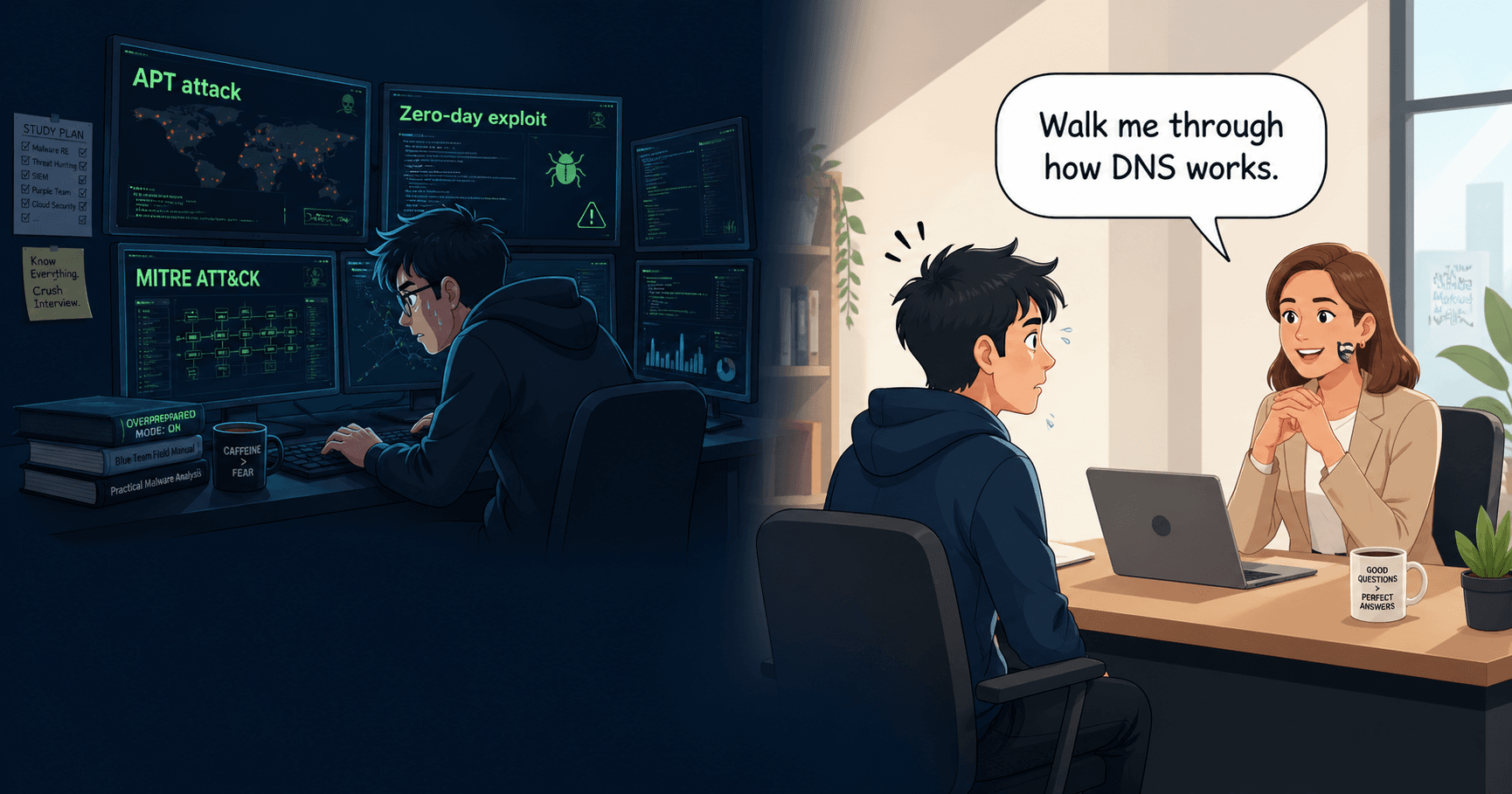
Most people preparing for their first cybersecurity job interview study too hard in the wrong direction. They watch senior-level mock interviews on YouTube, memorize incident response frameworks they have never used, and walk into the room ready to discuss advanced persistent threats. Then the interviewer asks, "Walk me through how DNS works," and the answer falls apart.
This is the calibration problem. Entry-level cybersecurity interviews are not scaled-down versions of senior interviews. They test different things entirely.
What entry-level interviewers are actually deciding
A hiring manager evaluating a first-job candidate is not asking, "Is this person a good analyst?" They are asking, "Is this person safe to train?"
Safe to train means: will they follow processes before improvising? Will they ask for help when they are stuck, rather than guessing? Will they document what they find? Will they admit when they do not know something?
These sound like personality traits, but they show up in technical answers. A candidate who says "I would isolate the endpoint immediately" without asking about scope is demonstrating impulsive judgment. A candidate who says "I would want to understand what triggered the alert and whether other systems are affected before deciding on containment" is demonstrating the kind of restraint that makes someone safe to put on a SOC (Security Operations Center) floor.
Pick a lane before you prepare
Cybersecurity is not one job. Even at the entry level, a SOC analyst interview and a GRC analyst interview ask fundamentally different questions. A SOC (Security Operations Center) interview is operational: alerts, triage, logs, escalation. A GRC (Governance, Risk, and Compliance) interview is analytical: risk, policy, controls, compliance evidence. Security engineering interviews are technical: infrastructure, hardening, identity, automation.
If you prepare for "cybersecurity" generically, you end up knowing a little about everything and not enough about anything. Pick one or two target roles and go deep on their question patterns.
Not sure which fits? Think about what kind of workday sounds good to you. If you want to investigate alerts and piece together evidence, that points toward SOC. If you want to map controls to frameworks and explain risk to executives, that points toward GRC. If you want to build and harden infrastructure, that points toward security engineering. Our SOC interview guide and junior SOC analyst question breakdown are good starting points if you are leaning that direction.
The technical bar is lower than you think
For a first role, you should be ready to talk through:
- How authentication differs from authorization, with an example
- What least privilege means and why it matters operationally
- How a phishing attack works from the attacker's perspective
- What DNS does, at a practical level
- What you would look for in logs if a user reported something suspicious
- How vulnerability management reduces risk
You do not need flawless answers. You need answers that are clear, cautious, and grounded in understanding rather than memorization. If you explain authentication and authorization by describing how a building keycard system works (the badge gets you in the door, but the access list determines which floors you can reach), that is more convincing than reciting a definition.
If you are changing careers, lead with the transfer
Many first cybersecurity jobs are not first jobs at all. They are career pivots from IT support, software development, systems administration, networking, or military service. If that describes you, the worst thing you can do is downplay your previous experience.
Each background transfers differently:
IT support taught you troubleshooting discipline, user communication, and the patience to gather information before escalating. Those are core SOC skills.
Systems administration gave you Windows, Linux, Active Directory, and hardening experience. You already think about configurations and access control daily.
Software development gave you code literacy, an understanding of application logic, and the ability to read logs that non-developers find opaque. AppSec (Application Security) and detection engineering value this heavily.
Networking gave you protocol knowledge, packet-level visibility, and segmentation awareness. Network security and SOC roles prize this background.
Military or government service gave you operational discipline, classified environment awareness, and clearance eligibility. These are concrete advantages, not soft skills.
Do not start your interview answer with "I do not have cybersecurity experience." Start with what you bring, and connect it to the specific role.
Your projects fill the gap that experience cannot
Whether you are a career changer or a recent graduate, hands-on projects are the strongest evidence you can bring. But the bar is not about complexity. It is about clarity.
A candidate who says "I set up a small Active Directory lab, created accounts with different privilege levels, and simulated a password spray attack to understand what the logs look like" has given the interviewer three important signals: initiative, structured thinking, and practical curiosity.
Compare that to "I am passionate about cybersecurity and I am a quick learner." One is evidence. The other is a claim.
Pick one project and prepare to walk through it in detail: what you set up, what problem you were investigating, what surprised you, and what you would change if you did it again. That last part matters. Interviewers use it to assess whether you reflect on your own work or just complete it and move on.
How to practice without wasting time
The most common preparation mistake is reading hundreds of questions and mentally rehearsing answers. That builds recognition, not fluency. When the interview happens and you have to produce answers verbally, with someone watching, the experience is completely different.
A better approach: pick five questions from your target role. Answer each one out loud, as if someone is in the room. If you ramble past ninety seconds, your answer is too long. If you cannot start without a filler word, you have not internalized the structure yet.
Record yourself if you can tolerate it. The gap between how your answer sounds in your head and how it sounds out loud is usually humbling, and that is exactly why this practice works.
The first cybersecurity interview you pass will probably not reward the most knowledgeable candidate. It will reward the one who sounds dependable, clear, and already pointed in the right direction. That is a learnable skill, and the preparation window is shorter than most people think.