What SOC Analyst Interviewers Actually Look For
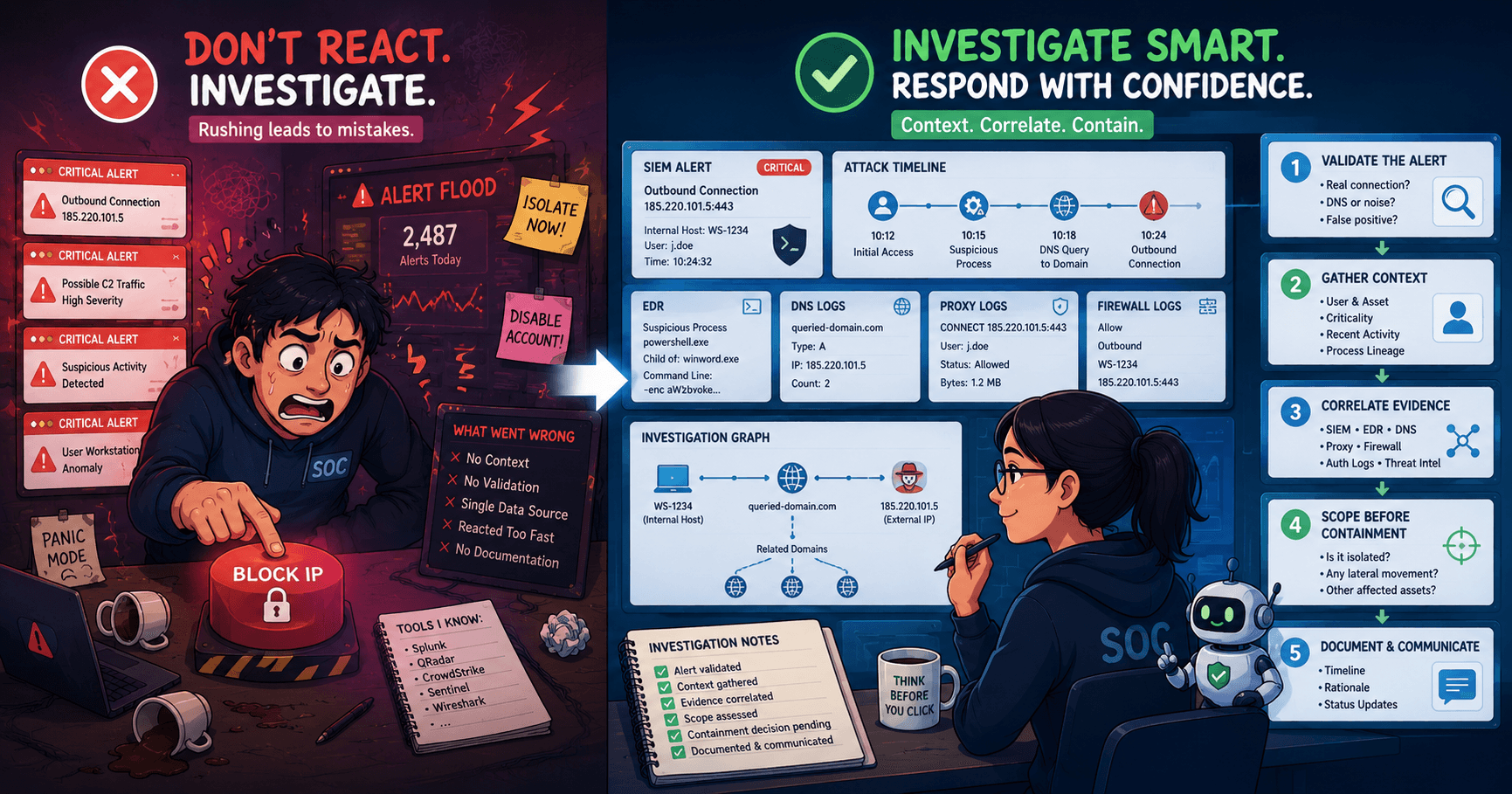
You are starting your shift when a critical SIEM alert fires: possible command-and-control traffic from an internal workstation. A weak answer jumps straight to blocking the IP or naming tools. A strong answer validates the alert, gathers host context, checks for spread, and decides on containment only after scoping what actually happened.
The Common Mistake
Most candidates answer this kind of SOC question as if the interviewer asked which products sit in the stack.
"I would check Splunk, look in CrowdStrike, block the IP on the firewall, and then investigate the host."
That sounds active, but it reveals very little judgment. The first problem is sequence. Blocking before validating or scoping can disrupt the attacker without understanding whether the workstation is one host in a larger compromise. The second problem is reasoning. The answer names tools, but it never explains what question each data source is supposed to answer. A SIEM is not a methodology. EDR is not a hypothesis.
Interviewers hear this pattern constantly, especially from candidates who have learned the tooling faster than the investigation logic. The weak answer also ignores business context. A finance workstation, an executive laptop, and a lab machine do not carry the same urgency or blast radius. If a candidate never mentions user role, recent activity, or whether the alert could be a false positive, they are describing button clicks, not triage.
What Interviewers Are Testing For
The underlying competency is disciplined alert triage under uncertainty. A good SOC answer shows that the analyst can turn a noisy detection into a defensible first response.
Interviewers usually listen for these patterns:
- Validation before escalation. Strong analysts ask whether the alert is a known false positive, what exactly triggered it, and how much confidence sits behind the indicator.
- Context before action. Host owner, asset criticality, recent user activity, and process lineage all change how the alert should be interpreted.
- Correlation across evidence. SIEM, EDR, firewall, proxy, and DNS data serve different questions. Strong candidates use multiple sources to confirm or disprove a theory.
- Scope before containment. The first compromised host is often not the only compromised host.
- Communication and documentation during the investigation, not after it.
Candidates usually fail in one of three ways: they treat a single data source as truth, they rush to containment without understanding spread, or they never articulate the decision threshold that would justify escalation.
Framework: First 30 Minutes
| Component | Weak version | Strong version | |---|---|---| | Alert handling | Assumes the detection is already confirmed | Validates confidence, trigger type, and false-positive history first | | Evidence use | Looks in one tool and moves on | Cross-references host, network, proxy, and authentication context | | Containment logic | Blocks fast without knowing scope | Contains based on scope, severity, and business impact | | Investigation output | Verbal update with few notes | Timeline, findings, rationale, and escalation status documented as the case evolves |
Strong Answer Breakdown
The strong answer usually begins with validation, not action:
"First I want to understand what the alert actually represents. Is this a confirmed outbound connection, a DNS lookup, or just a match on an artifact in telemetry? I would review the detection logic and the indicator confidence so I know whether I am looking at likely command-and-control or noisy enrichment.
Next I would gather host context: which user owns the workstation, what the system does, whether there was recent suspicious process execution, and whether the same domain or IP appears anywhere else in DNS, proxy, or firewall data. That tells me whether this is isolated or part of a broader problem.
I would use EDR to identify what process initiated the traffic, then correlate with other evidence such as authentication events, persistence indicators, and any signs of lateral movement. If this is a single host with credible C2 behavior, containment becomes a live option. If several systems show the same pattern, I escalate immediately and coordinate before isolating anything.
While doing this, I document the timeline and update the incident lead with current confidence, scope, and next actions."
That answer mirrors the expected answer closely. Validation protects against wasting time on bad detections. Host context and asset criticality keep the analyst from treating every alert as identical. Multi-source correlation reduces the risk of drawing conclusions from a single telemetry feed. Scoping before containment avoids the classic mistake of reacting to the first host and missing the wider compromise. Documentation matters because SOC work feeds incident response, threat hunting, and later review. A candidate who mentions it unprompted signals operational maturity.
Why This Distinction Matters
SOC teams do not get judged on how quickly they click into tools. They get judged on whether the first thirty minutes reduce uncertainty without making the situation worse. A strong analyst knows when an alert is still just an alert, when it has become an incident, and which facts are needed before taking an irreversible action.
That skill outlasts any specific platform. Tool names change. Triage logic does not. Analysts who validate, scope, correlate, and document are the ones who produce better escalations, cleaner handoffs, and faster incident containment.
Red Flags
- Tool recital. The answer lists products without explaining what question each data source is meant to answer.
- Immediate blocking. The candidate contains before determining whether the host is one system or one symptom.
- Single-source confidence. One log source is treated as enough evidence to decide severity and scope.
- No documentation. Findings are described as if memory is sufficient and handoff quality does not matter.
- No business context. Asset criticality and user role never enter the triage decision.
Key Takeaways
- Validate before acting. Not every high-severity detection is equally trustworthy.
- Correlate across sources. One telemetry feed rarely gives enough confidence on its own.
- Scope before containing. An isolated reaction can hide a larger compromise.
- Document in real time. Incident response depends on clean, defensible handoff notes, not memory.