You Are the First AppSec Hire at a Startup. Where Do You Start?
Imagine this: you just joined a 60-person startup as the first AppSec (Application Security) hire. Fifteen engineers shipping fast. No security process. No SAST in the pipeline. No threat models. The engineering VP tells you on day one: "We need to get secure without slowing down." What do you do?
That scenario, or something close to it, shows up in nearly every AppSec interview. AppSec teams focus on helping engineers build and ship software securely. The answer reveals whether you think about security as a gate or as a practice.
The gate model and why it fails
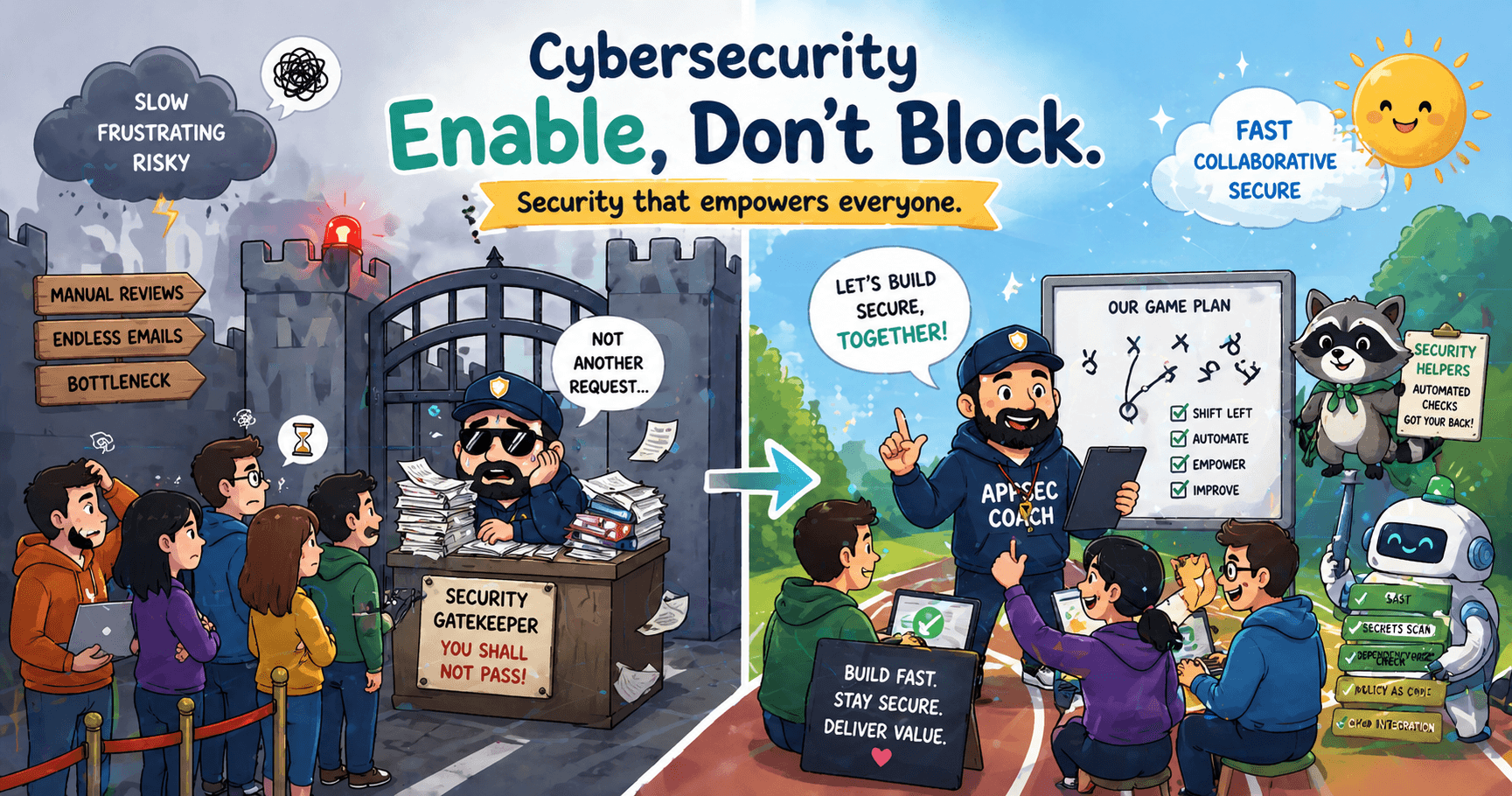
The most common weak answer describes building a security checkpoint:
"I would review all code before production, run SAST and DAST tools on every build, create tickets for vulnerabilities, and require sign-off from the security team before major releases."
This describes a bottleneck. One AppSec person reviewing all code for fifteen engineers creates adversarial dynamics and delayed releases. Interviewers who have worked inside engineering organizations know exactly what this model produces: a dev team that learns to minimize what they show the security team. An AppSec gate that only produces complaints trains engineers to hate security.
How a strong candidate actually approaches this
The best answer one AppSec hiring manager described hearing started with: "I would spend my first two weeks not writing any policies."
That candidate spent those two weeks talking to engineering: understanding the stack, the deployment pipeline, what they were building, and where the genuinely high-risk areas were. You cannot prioritize without context, and an AppSec program built without understanding the engineering culture will fail regardless of how technically sound it is.
Here is what a phased approach looks like:
First 30 days: high-impact, low-friction wins. Get secrets detection into the CI/CD pipeline. That catches a real category of critical issues automatically with minimal workflow disruption. Run lightweight threat models on the two or three highest-risk features, with the developers who built them in the room. The goal is to teach the process, not just find issues. Document the top five security anti-patterns common in the stack.
First quarter: build the multiplier. Establish a security champions program: one developer per team who has a bit more security context and can catch issues in code review before they reach you. That scales coverage without scaling headcount. Add SAST to the pipeline with tuned rules (raw SAST output has high false positive rates, and distributing unfiltered findings erodes trust). Build secure defaults: approved libraries, security-reviewed templates, internal documentation that makes the secure choice easier than the insecure one.
After trust is established: add review gates. Only now does a security review gate make sense, because you have built enough tooling and relationships that the gate adds value rather than friction.
This sequencing is what interviewers care about. Not whether you know the right controls, but whether you can deploy them in an order that actually works.
What interviewers are really evaluating
AppSec interviews test three things that go beyond technical bug-finding:
Developer psychology. Developers are not adversaries. They are partners who need security to be easy, not punitive. A candidate who proposes strict controls without addressing user experience shows limited operational awareness. This is the same usability tension that security engineers face when designing systems.
Leverage. Your time is finite. Threat modeling sessions, secure defaults, and security champions all multiply impact without multiplying hours. An AppSec program that finds 200 vulnerabilities and remediates 20 is worse than one that prevents 50 from being introduced.
Communication. A finding that developers understand and can fix is more valuable than a comprehensive report they ignore. How you explain risk matters.
The anti-patterns that get you filtered
Treating SAST output as findings without triage. Unfiltered SAST output lands on developers as noise. They stop reading it, stop trusting it, and eventually stop trusting the AppSec function that sent it.
Ignoring business context. "Fix all critical vulnerabilities immediately" is not a plan. Remediation timelines need to account for engineering capacity, product roadmap, and actual exploitability.
No mention of developer enablement. If your entire answer is about finding bugs, you are describing a reactive AppSec function. Strong candidates talk about building capability across the engineering org.
No discussion of metrics. If you cannot measure whether your program is working, you cannot improve it or justify it. Strong candidates think about program health in measurable terms: how fast issues get fixed, how often they reopen, how many are caught before production versus after. Raw vulnerability counts tell you almost nothing.
This tension between security coverage and developer friction shows up in every domain. Mobile security and privacy engineering interviews ask the same underlying question: did you build security into the process, or did you add it on top and hope it stuck?
AppSec interview questions on MyKareer go beyond OWASP lists. Practice with real scenarios.