Junior SOC Analyst Interview Questions: The Entry-Level Topics That Matter
Junior SOC (Security Operations Center) analyst interviews are entry-level by title, but they still filter hard. Teams are not looking for someone who has mastered incident response. They are looking for someone who can triage carefully, document clearly, and avoid making bad assumptions with incomplete data.
That is why junior SOC analyst interview questions often focus on a narrow set of topics rather than broad security trivia.
What junior SOC interviews usually cover
Expect questions around:
- alert triage
- phishing analysis
- Windows and network logs
- suspicious process behavior
- escalation decisions
- false positives versus true positives
- communication and documentation
The goal is not to prove that you can lead a major breach investigation alone. The goal is to prove that you can be trusted with first-line analysis and that you know when to escalate.
Common junior SOC analyst interview questions
These are the patterns that come up repeatedly:
- What would you do when an alert fires on a user workstation?
- How would you investigate a suspected phishing email?
- What is the difference between a false positive and a false negative?
- Which logs would you check first during an investigation?
- What signs might suggest credential abuse?
- When should a Tier 1 analyst escalate an alert?
- How would you document your findings?
- What is the difference between EDR and SIEM?
Notice what these questions have in common. They are operational. A junior SOC analyst is expected to observe, verify, document, and escalate. Interviewers are listening for a process, not a stream of tool names. EDR means endpoint detection and response, while SIEM means security information and event management.
What a strong junior SOC answer sounds like
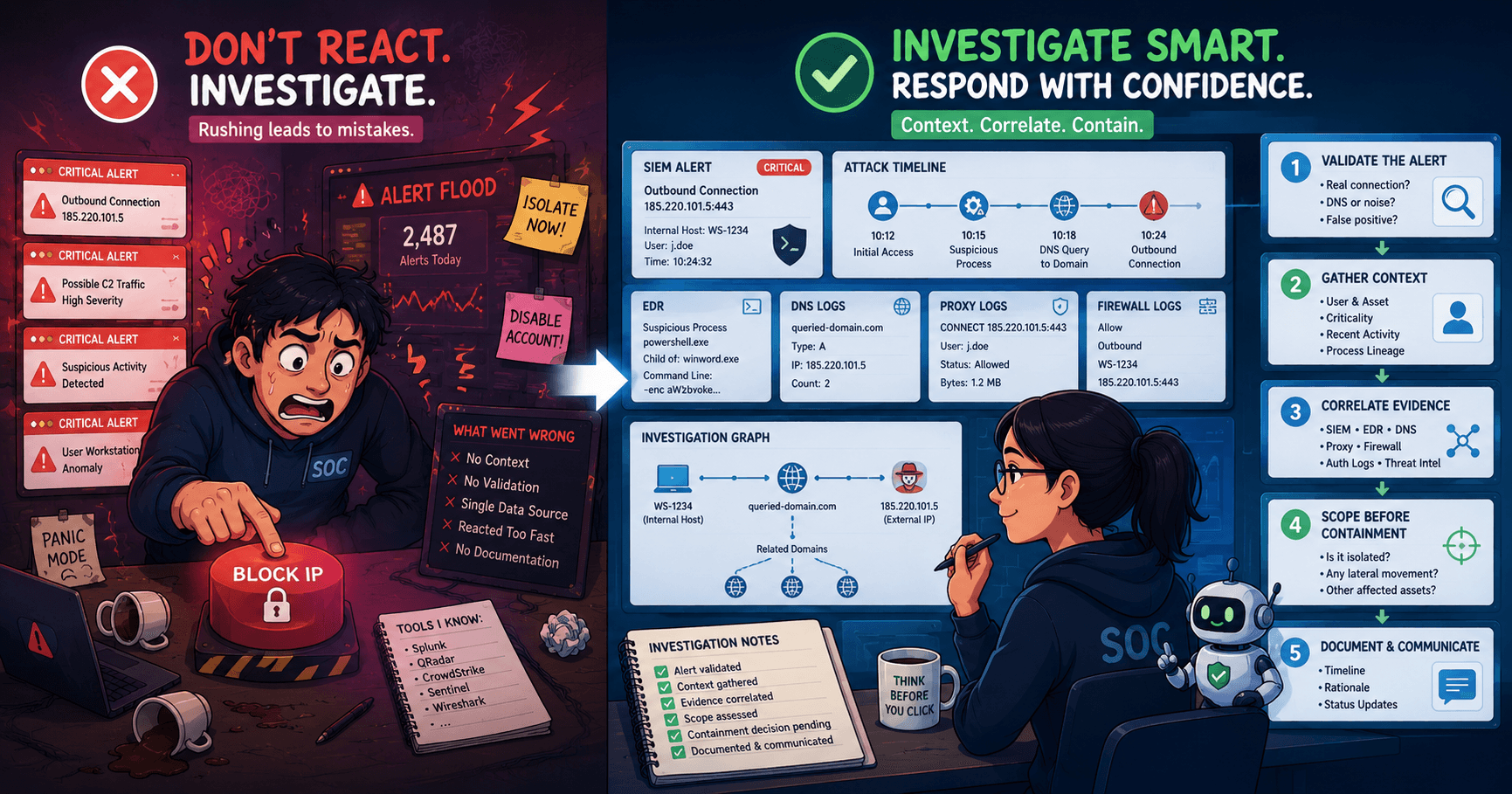
A strong answer usually starts with validation. Before acting, you confirm what the alert actually says, which host or account is involved, when it fired, and whether there is obvious context from prior alerts or tickets. Then you move into focused evidence gathering: endpoint telemetry, process execution, user context, authentication events, DNS activity, proxy logs, or email metadata depending on the case.
Finally, you explain the decision point. Is this benign activity, suspicious activity that needs more context, or something that should be escalated immediately? Junior candidates often miss that final step. They describe investigation but never describe decision-making.
Topics you should prepare in advance
For a junior SOC role, make sure you can explain:
- basic phishing indicators
- why process trees matter
- what failed logons can and cannot mean
- why endpoint, email, and network telemetry complement each other
- how ticket notes should distinguish facts from assumptions
- when containment is not something Tier 1 should do alone
If you need deeper context on the interviewer side of this role, read What SOC Analyst Interviewers Actually Look For. That article covers the reasoning patterns hiring managers value after the basics are already in place.
The biggest mistakes early-career candidates make
The first mistake is answering with tools instead of method. Naming products is not an investigation plan. Describing what you are trying to confirm at each step, and why, is much stronger.
The second mistake is overcommitting. Junior analysts are supposed to escalate when needed. If your answer implies you would isolate hosts, reset accounts, or declare incidents without coordination, you may sound reckless rather than capable.
The third mistake is inventing confidence. Good SOC work depends on disciplined uncertainty. If you only have partial data, say so and explain what you would need next.
How to prepare for a junior SOC interview
The best preparation is repetitive scenario practice. Pick a short set of recurring cases:
- suspicious login activity
- phishing email
- unusual PowerShell or script execution
- malware alert on a workstation
- impossible travel or account takeover signal
For each one, practice four moves:
- define the immediate risk
- name the evidence sources you would check
- explain what would change your confidence
- state when and why you would escalate
That loop builds the skill the role actually needs. If you are still earlier in the funnel and deciding between internship, apprenticeship, or a junior analyst role, start with how to prepare for your first cybersecurity job interview. If you are targeting broader early-career search terms, our cybersecurity internship interview questions guide is the companion piece.