Your IR Team Hands You a Suspicious Binary. What Do You Do First?
Your IR team hands you a suspicious binary pulled from a compromised endpoint. The alert fired because of an unusual outbound connection. You have twenty minutes before the incident lead wants a preliminary assessment. What do you do first?
If your instinct is to open IDA Pro and start analyzing imports, you have already made the most common malware analysis interview mistake. Interviewers are not testing whether you can reverse engineer a binary. They are testing whether you can triage a threat quickly, safely, and with purpose.
Start with the question, not the tool
Before you touch the file, you need context. Where was this binary found? What behavior triggered the alert? What host and user were involved? Is this part of a broader active incident that changes the urgency?
That context shapes everything. A binary found on a domain controller during a confirmed breach gets very different treatment than a suspicious attachment flagged by email filtering.
Next: environment. You need an isolated sandbox with network simulation, not live internet access. This sounds obvious, but interviewers specifically listen for it because skipping environment setup is a foundational safety issue. Analysts who do not mention isolation are either inexperienced or sloppy.
The triage progression
Think in three stages, and spend most of your time in the first two.
Orient. Gather context from IR. Understand the potential blast radius. This shapes urgency and depth. A colleague once described spending two hours reversing a binary that turned out to be a known commodity, already classified and blocked by three different vendors. Two minutes of hash lookups would have saved the entire effort.
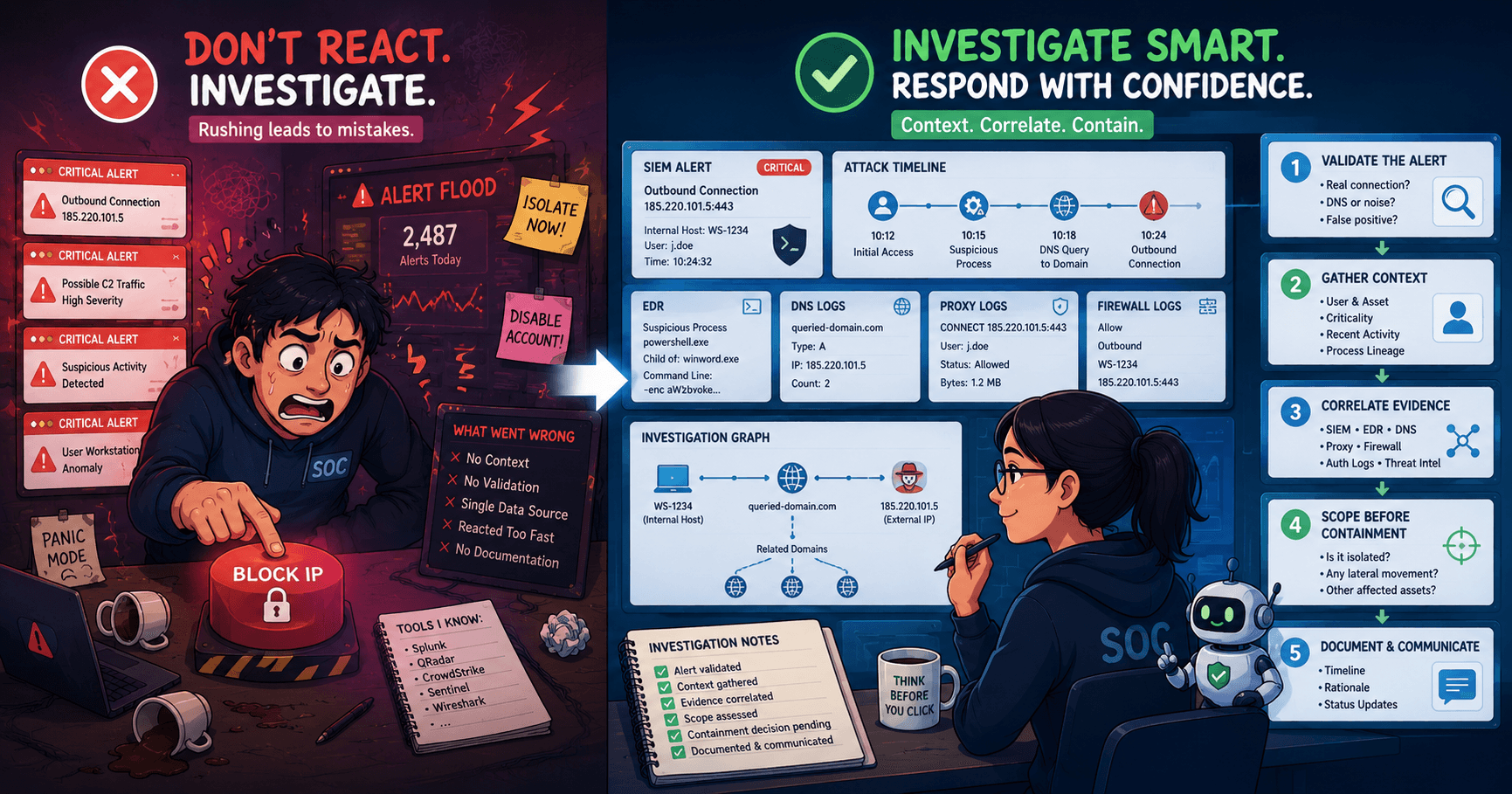
Classify quickly. Hash lookups against VirusTotal and internal threat intel. If it is already known, you have a starting point. If it is unknown or low-prevalence, that is itself a signal worth flagging. Then behavioral analysis: run it in a sandbox and watch what it does before you try to understand how it does it. Process creation, file writes, registry changes, network behavior. Behavioral output gives you the 80% answer fast.
Go deep only when needed. Unpacking, disassembly, debugging, config extraction. This is high-value but time-intensive. You go here when behavioral analysis is not enough, when you need to extract IOCs for detection rules, when you are trying to understand a novel capability, or when the threat intelligence team needs details for attribution.
Most analysts under incident pressure should spend the majority of their time orienting and classifying. Interviewers want to know you understand that.
What this sounds like at different levels
The triage framework is the same at junior, mid, and senior. What changes is the depth and the follow-through.
Junior answer: Gets the sequence right. Asks for context, sets up isolation, runs the hash, runs the sandbox. Describes what to look for in behavioral output. Stops there.
Mid-level answer: Everything above, plus: explains why each step matters, not just what it is. Mentions sandbox evasion as a possibility and what that implies for next steps. Starts connecting behavioral findings to detection: "if I see these registry writes, I can draft a Sigma rule for the SOC immediately."
Senior answer: Starts with scope and escalation decision, not just triage steps. Considers whether this binary warrants pulling in threat intel for attribution. Talks about what a clean sandbox run does and does not mean, accounts for evasion, and knows when to stop and hand off versus when to go deeper. When the behavioral analysis is inconclusive, explains the static analysis approach and what they are specifically trying to answer, not just "look at imports."
If you are interviewing for a senior role and your answer sounds like the junior answer above, that is a gap interviewers will notice.
What this sounds like in an interview
"I start with context: what do we know about the endpoint, the user, the connection that triggered the alert? That shapes my hypothesis before I look at the file. Then I verify my analysis environment is isolated and snapshot-ready.
I run the hash against our threat intel and VirusTotal. If it is a known family, I have a starting point and can validate against known signatures. If it is unknown or low-prevalence, I treat that as higher priority.
I run it in a sandbox first. I want to see what it does before I try to understand how it does it. I am looking at process creation, file writes, registry changes, network behavior. That gives me the behavioral profile and lets me draft IOCs for the SOC quickly.
If the sandbox shows the binary detecting the environment and not executing its payload, that is information too. I would document it and adjust: different sandbox configuration, or move into static analysis to understand the evasion logic. Specifically, I would look at anti-analysis checks in the imports or strings, then trace the execution path to understand what condition it is checking before running."
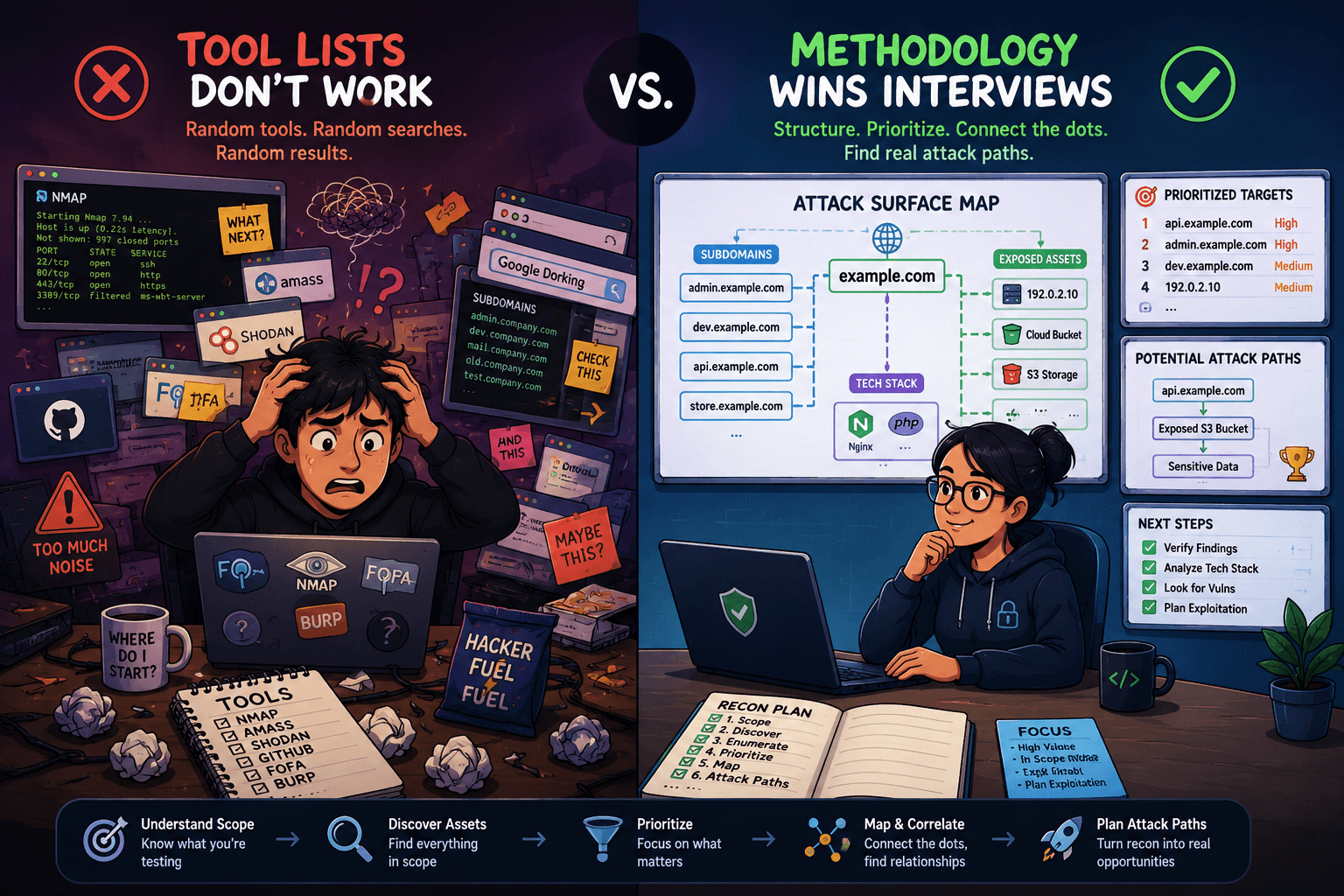
This answer is not more technical than a tool-focused answer. It is more methodical. Every step has a reason, and the candidate knows when to go deeper versus when to stop.
Follow-up questions interviewers ask
"VirusTotal is clean but sandbox behavior looks suspicious. Now what?"
This is the real test. A clean hash does not mean benign. It means unknown to public threat intel. You treat unknown and suspicious as higher priority, not lower. You look more carefully at behavioral signals: unusual parent-child process relationships, low-prevalence network destinations, writes to persistence locations. You escalate to static analysis if behavioral output is not conclusive. What you do not do is close the ticket because VirusTotal said clean.
"The binary detects your sandbox and does nothing. How do you proceed?"
You adapt the environment first: change sandbox timing, inject into a running process, modify VM artifacts that malware typically checks (registry keys, hardware fingerprints, running processes). If it still evades, you move to static analysis with a specific goal: find the evasion check, understand what condition it is looking for, and either replicate that condition in the sandbox or analyze the actual payload path directly in a disassembler.
"When do you escalate versus keep analyzing?"
Escalate when: the binary is active on multiple hosts, when there are signs of lateral movement, when you have enough IOCs to brief the IR lead and blocking can start, or when deeper analysis will take longer than the business can wait. Analysis depth is a resource allocation decision, not just a technical one.
What concerns interviewers
Starting analysis without isolation. Running an unknown binary carelessly can expose production systems or corrupt forensic evidence. Analysts who skip this are a liability.
Treating everything as a static analysis problem. Defaulting to disassembly first is slow. Most threats reveal themselves faster through behavioral observation. Static analysis is for when behavioral is not enough.
Not asking about context. If you do not know whether this binary is part of a larger active incident, you might spend time on deep analysis when you should have escalated ten minutes ago.
No mention of sandbox evasion. Modern malware commonly checks for sandbox environments before executing. A clean sandbox run is not a green light. Analysts who treat it as one will misclassify threats.
Confusing depth with thoroughness. Reversing every binary completely is not thorough. It is slow. Thoroughness means answering the right questions efficiently and knowing when to stop.
Jumping to attribution too early. Junior analysts sometimes want to identify the threat actor before they have contained anything. Attribution is a threat intel question, not a triage priority.
Building triage instincts
The best way to improve is to practice narrating decisions, not just running tools. Take any sandbox report and explain, in 90 seconds, what you would do next and why. Practice answering: "What did you learn, and what questions does that open?"
Work through real scenarios on platforms like Any.run or Hybrid Analysis. Review published malware reports and ask yourself, at each stage, what your next step would have been before reading ahead.
MyKareer's malware analysis practice questions cover triage decisions, escalation calls, and static analysis methodology across junior, mid, and senior levels. Start with the free questions to see where your gaps are.