The AI Vulnerability Storm: Building a Mythos-Ready Security Program
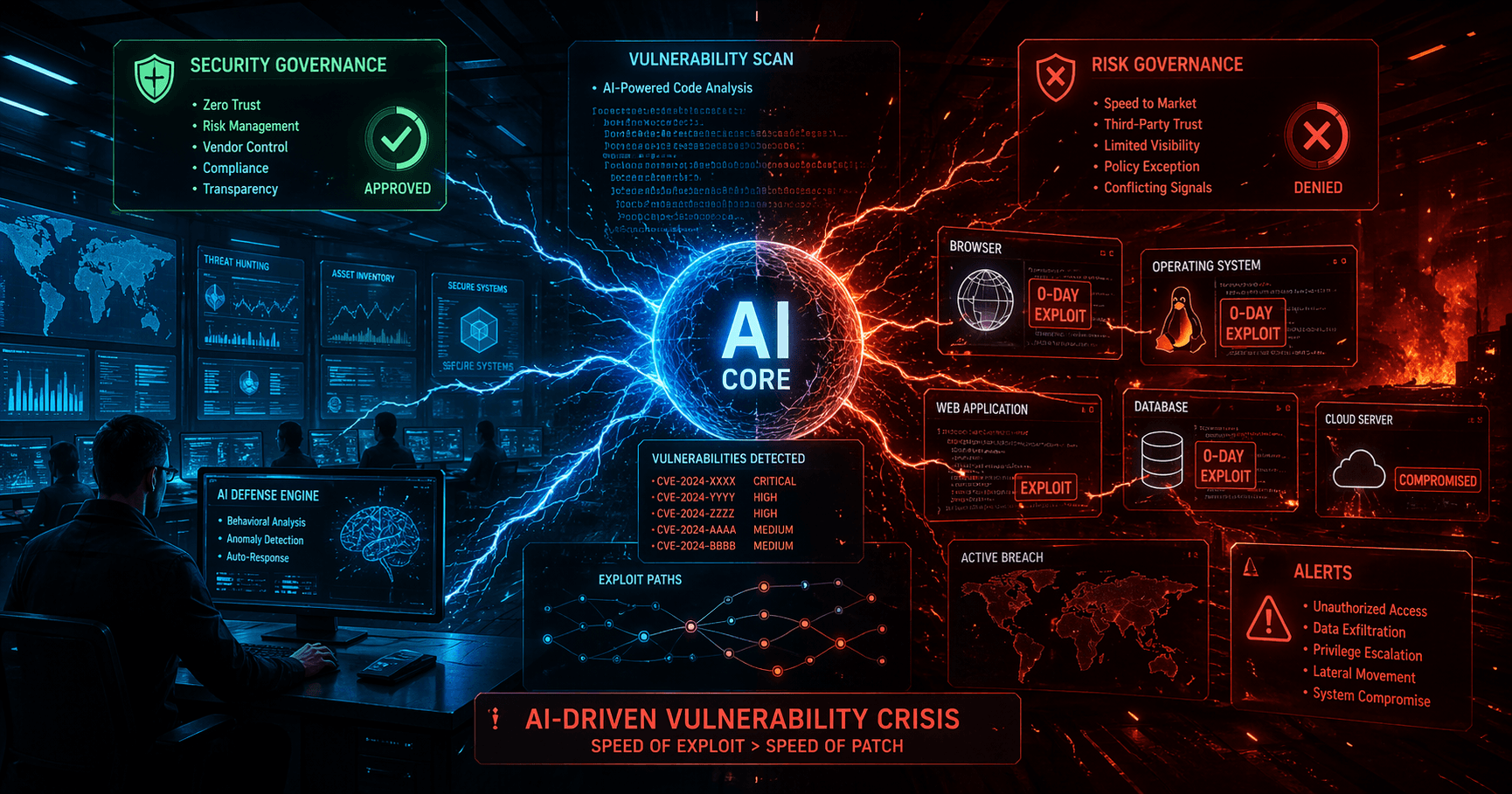
72% exploit success rate. Thousands of zero-days across every major OS and browser. A 27-year-old OpenBSD vulnerability found by AI in minutes.
Mean time-to-exploitation has collapsed from 2.3 years in 2018 to 10 hours in 2026. This year, 72.7% of exploited CVEs are zero-days: exploitation happened before or on the day of disclosure. Those two numbers, from 3,531 CVE-exploit pairs tracked by zerodayclock.com, define the new baseline.
Anthropic's Claude Mythos (Preview) is the forcing function. Internal testing showed Mythos generated 181 working exploits on Firefox where Claude Opus 4.6 succeeded only twice under identical conditions. This is not an incremental improvement. It is a step-change that renders human-speed patch cycles, CVE workflows, and quarterly risk metrics obsolete.
And the governance picture is equally fractured: the NSA is currently using Mythos for vulnerability scanning while the Pentagon simultaneously argues in court that Anthropic's tools threaten national security. Same model. Same vendor. Two irreconcilable positions inside one government. Enterprise security programs face the same fragmentation risk at smaller scale, and most have no continuity plan for it.
This post maps what practitioners must do. Now.
Anatomy of the Capability Shift
Mythos exhibits two capabilities that distinguish it from prior AI models:
1. Single-prompt exploitation. Mythos generates working exploits with one prompt, no agent configuration or multi-step orchestration required. Prior models needed extensive scaffolding to reach the same output; Mythos produced 181 working Firefox exploits where Claude Opus 4.6 succeeded twice under identical conditions.
2. Complex, chained vulnerabilities. The model identifies vulnerabilities composed of multiple primitives chained together, including scenarios requiring several memory corruption bugs combined into a single exploit path, the kind of multi-step reasoning that previously required a skilled human researcher.
The timeline shows the acceleration:
| Date | Event |
|---|---|
| Jun 24, 2025 | XBOW tops HackerOne leaderboard, first autonomous system to outperform all human hackers |
| Aug 5, 2025 | Google Big Sleep finds 20 real zero-days in open source (FFmpeg, ImageMagick) |
| Aug 8, 2025 | DARPA AIXCC finds 54 vulnerabilities in four hours across 54 million lines of code |
| Nov 14, 2025 | First AI-orchestrated espionage campaign disclosed (Chinese state-sponsored group using Claude Code) |
| Feb 5, 2026 | Anthropic reports 500+ high-severity bugs; AISLE finds 12 OpenSSL zero-days including CVSS 9.8 flaw from 1998 |
| Mar 2026 | Linux kernel bug reports climb from 2 to 10/week, all verified real; curl project discontinues bug bounty due to AI "slop" |
| Apr 7, 2026 | Claude Mythos Preview announced with Project Glasswing coordination |
| Apr 19, 2026 | NSA confirmed using Mythos despite DoD supply-chain blacklist; mean TTE reaches 10h; 72.7% of exploited CVEs are zero-days (zerodayclock.com) |
Mean TTE has crossed the 1-day threshold and is projected to reach 1 hour within 2026. The traditional 30-day patch window no longer describes the actual threat environment for the majority of exploited CVEs.
| TTE Milestone | Status | Year |
|---|---|---|
| 1 Year | Reached | ~2021 |
| 1 Month | Reached | ~2025 |
| 1 Week | Reached | ~2026 |
| 1 Day | Reached | ~2026 |
| 1 Hour | Projected | ~2026 |
| 1 Minute | Projected | ~2028 |
A note on access, cost, and reality.
Access: Mythos has no GA timeline. Anthropic will not release it broadly until stronger guardrails exist. Project Glasswing exists because model access alone is not the answer: coordinated disclosure with vendors is the actual mechanism.
Cost: Finding a vulnerability requires many iterations. The cost is the full compute across all runs, not the single run that succeeds. Today's real threat is Glasswing's patch wave, not open attacker access to Mythos.
The harder truth: Most organizations still carry old vulnerabilities in production. Not because they weren't discovered, but because remediation gets blocked by organizational friction. Mythos surfaces more findings into a system already failing to act on known ones. The real leverage is patch prioritization and the governance muscle to push remediation through. Mythos makes the cost of inaction higher. It does not make it easier to act.
MITRE ATT&CK Techniques
Mythos is a capability accelerator, not a single attack chain. The most directly evidenced technique is T1190 - Exploit Public-Facing Application (Initial Access): Mythos autonomously finds and generates working exploits against public-facing applications at scale, demonstrated across every major OS and browser.
What a Security Professional Would Do
GRC / Security Leadership
The CISO function must act first because every other action depends on governance decisions made this week.
Immediate actions (this week):
-
Update risk calculations. Pre-Mythos risk models assumed patch windows measured in days or weeks. Those models now understate exposure. Re-evaluate risk tolerance for operational downtime caused by vulnerability remediation.
-
Formalize AI agent adoption. Draft and circulate a policy that explicitly allows security staff to use AI coding agents for vulnerability discovery, code review, and incident response. The alternative, shadow AI usage without oversight, introduces more risk than structured adoption.
-
Establish innovation governance. Create a cross-functional mechanism (Security, Legal, Engineering) to evaluate new offensive threats and accelerate onboarding of defensive technologies. Without this, approval friction will slow deployment to the attacker's advantage. Bureaucracy is now a security risk.
-
Treat AI security tools as tier-1 vendors. For every AI tool in your security stack, document a substitution plan, identify at least one operational alternative, and define a 30-day continuity window. The NSA/Pentagon split is a live example: the DoD blacklisted Anthropic while the NSA kept using Mythos. That bifurcation happens at enterprise scale too.
-
Review vendor capability carve-outs. Anthropic was blacklisted specifically because it refused to enable mass domestic surveillance and autonomous weapons. Knowing what your vendor will and will not do under pressure is now a procurement requirement. Read the contracts.
-
Address the regulatory liability shift. The EU AI Act (August 2026) introduces automated audit and incident reporting requirements around AI. When AI scanning tools are broadly available and your organization did not use them, boards will face questions about whether that constitutes negligence. Document your AI scanning posture now, before an incident forces the question in front of auditors or counsel.
-
Brief the board. Prepare talking points that justify current program investments and make the case for additional headcount and budget for reserve capacity.
Key metric shifts:
- From "time to patch" to "time to detect and contain"
- From "number of CVEs resolved" to "blast radius of exploited vulnerabilities"
- From "quarterly pen test findings" to "continuous AI-driven vulnerability discovery"
AppSec / Engineering
This week:
-
Point agents at your code. Start by asking an AI agent for a security review of any code, then build toward a VulnOps capability. Shift left by adding AI-driven security review directly into developers' coding agents.
-
Require AI-driven review before merge. All code (human or AI-generated) should pass LLM-driven security review before reaching production. Commercial options include Claude Code Security from Anthropic and Codex Security from OpenAI. Open source options include OpenAnt from Knostic and raptor.
-
Audit your CI/CD pipeline. Ensure disciplined control repos, artifacts, and software including agentic supply chain such as MCP servers, plugins, and skills. The agent harness (prompts, tool definitions, retrieval pipelines, escalation logic) is where consequential failures occur.
Next 45 days:
- Build VulnOps function. Stand up a permanent Vulnerability Operations capability staffed and automated like DevOps, but for autonomous vulnerability research and remediation. This function owns continuous discovery of zero-day vulnerabilities across your entire software estate.
SOC / Blue Team
This week:
-
Prepare for alert volume spikes. AI-accelerated vulnerability discovery means your SIEM will see increased scanning and exploitation attempts. Update correlation rules and consider automated triage for known AI-discovered vulnerability patterns.
-
Verify segmentation. A flat or insufficiently segmented network gives every successful exploit leverage. AI-driven attacks worsen this through automated multi-hop lateral movement that exploits poor architecture faster and more creatively than manual attackers.
Next 45 days:
-
Build deception capability. Deploy canaries and honey tokens, layer behavioral monitoring, and pre-authorize containment actions. Deception is attack-tool and vulnerability independent, identifying attackers based on their TTPs rather than known signatures.
-
Update playbooks for simultaneous incidents. Run tabletop exercises for multiple high-severity incidents occurring within the same week. Examine how to automate remediation capabilities to the degree possible.
Incident Response
This week:
-
Pre-authorize containment actions. Define scope boundaries, blast-radius limits, escalation logic, and human override mechanisms for agents deployed in or adjacent to production environments. Do not wait for industry governance frameworks.
-
Update communication plans. Include technical and communications response plans to execute at the required speed and scale, including coordination for simultaneous incidents.
Next 90 days:
- Build automated response capability. Improve detection engineering and incident response to be systemic and, to the degree possible, autonomous. Examples include asset and user behavioral analysis, pre-authorized containment actions, and response playbooks that execute at machine speed.
Security Engineering
This month:
-
Harden the environment. Implement egress filtering (it blocked every public log4j exploit), enforce deep segmentation and zero trust where possible, lock down the dependency chain, and mandate phishing-resistant MFA for all privileged accounts.
-
Inventory and reduce attack surface. Start with critical internet-facing systems, build toward a full-coverage inventory over 45 days. Generate real SBOMs. Aggressively shut down unneeded or unmaintained functionality.
Key insight: Software minimization reduces the operational overhead of patching. Minimizing base OS images or replacing third-party libraries with framework primitives reduces exposure. AI can accelerate this.
Key Takeaways
- You cannot outwork machine-speed threats. The cadence and volume of vulnerability disclosures will exceed anything previously experienced. Re-prioritize, automate, and prepare for burnout mitigation.
- Agents are now required, not optional. Without agents, most defensive tasks become untenable. Formalize AI agent usage across all security functions with mandatory security controls and oversight.
- Inventory determines defendability. You cannot patch, segment, or defend what you do not know exists. Build continuous inventory updates using agents to accelerate the process.
- Basics still matter, but must execute faster. Segmentation, patching known vulnerabilities, identity and access management, and defense-in-depth all increase attacker difficulty. The difference now is the speed at which these must operate.
- Collective defense is no longer optional. Engage with sector coordinating groups, ISACs, CERTs, and standards bodies to share threat intelligence and coordinate response. Attackers already operate as syndicates. Defenders must match that coordination.
- AI vendor access is not guaranteed. Treat AI security tooling with the same vendor risk management applied to any critical third party: documented alternatives, contractual exit terms reviewed, and the vendor's capability refusal posture understood before deployment.
- Discovery is not the bottleneck. Most organizations already know about vulnerabilities they haven't patched. Mythos raises the stakes for that inaction. Fix the remediation pipeline before optimizing discovery.
Synthesis
The Mythos announcement is not a call to panic. It is a forcing function for decisions that should have been made over the past 12 months as AI capabilities escalated. The organizations that respond well will be those that build the muscle now: the processes, the tooling, and a culture willing to adopt AI as a core part of how security gets done.
Being Mythos-ready means engineering a resilient architecture that limits the ability of attackers to exploit discovered vulnerabilities and contains the impact if they are exploited. It means discovering more vulnerabilities yourself in advance of any adversary. It means responding quickly to incidents at scale.
The time available for action is shrinking. Long-term goals should be considered a quarter away, at most. Start with what you can unblock today.
Practice on MyKareer
The methodology in this post maps directly to Security Engineer and GRC interview preparation on MyKareer, where candidates practice articulating control prioritization, risk communication, and architectural decision-making under constraint.
Start Security Engineer Practice | Start GRC Practice
References
Related articles
 Security Strategy
Enterprise AI Governance: How to Secure LLM Usage Without Slowing Down Innovation
 Threat Analysis
What Shai-Hulud Teaches Cybersecurity Candidates About Trust in Software
 Threat Analysis