The First-Hour Question That Separates Strong IR Candidates
Your monitoring team flags a domain controller making outbound connections while authentication failures spike across the environment. A weak answer isolates systems immediately or starts naming tools. A strong answer triages the competing risks first: whether the host is truly compromised, what evidence could be lost, how wide the incident might be, and which actions would create operational damage before the facts are clear.
The Common Mistake
Many candidates hear an urgent incident scenario and assume speed matters more than structure.
"I would isolate the domain controller, block the IP, reset affected accounts, and start pulling logs."
That answer sounds decisive, which is why it traps people. The issue is not lack of energy. The issue is bad sequencing. A domain controller is not a normal endpoint. Abruptly isolating it can break authentication across the environment. Resetting accounts before understanding whether the issue is a credential attack, a compromised host, or both can destroy valuable evidence and disrupt business operations at the same time.
The weak answer also treats the first indicator as the whole incident. Outbound traffic plus authentication failures could point to several realities: an already-compromised controller, failed attacker expansion, or a noisy adjacent symptom from another system. Candidates who collapse all of that into one reaction are not demonstrating incident leadership. They are demonstrating panic with better vocabulary.
What Interviewers Are Testing For
This question tests judgment in the first hour, not completeness. Interviewers know the responder will act with incomplete information. They want to see whether the candidate can make the uncertainty manageable.
The strongest answers usually show four things:
- Hypothesis-driven triage. The candidate names more than one plausible explanation and gathers evidence to narrow them.
- Evidence awareness. They understand that containment can conflict with preservation.
- Operational caution. They recognize that a domain controller carries infrastructure dependencies that change the response.
- Communication discipline. Leadership, infrastructure teams, and incident leads need updates before the responder has a perfect picture.
Typical failure patterns are easy to recognize:
- Immediate containment without assessing operational impact.
- No mention of memory capture, timeline preservation, or artifact loss.
- Silent investigation with no escalation path.
- Treating all incidents as if they share the same first-hour priorities.
Framework: First-Hour IR
| Component | Weak version | Strong version | |---|---|---| | Initial framing | Assumes one obvious explanation | States competing hypotheses and gathers evidence to separate them | | Containment | Acts immediately with little regard for side effects | Balances business impact, attacker awareness, and evidence preservation before containment | | Evidence handling | Pulls logs later or not at all | Protects volatile and high-value artifacts early | | Communication | Investigates in isolation | Updates the incident lead and coordinates with impacted teams as the picture develops |
Strong Answer Breakdown
The strong version usually sounds like this:
"My first step is to understand which problem I am actually dealing with. A domain controller making outbound connections plus authentication failures could indicate a compromised controller, attacker-driven lateral movement, or a separate authentication attack that only overlaps in time. I would gather process and network context on the outbound traffic, then compare that with the sources and timing of the failed authentications.
I would notify the incident lead early because the indicators are severe enough to justify coordination now. If the controller does look compromised, I would not isolate it casually. I need to understand directory dependencies, capture volatile evidence, and work with infrastructure on a containment path that does not create a second outage.
At the same time, I would begin scope checks: whether any authentications succeeded, whether other systems show related indicators, and whether there are signs of lateral movement. Every action in the first hour should reduce uncertainty without destroying evidence or breaking operations unnecessarily."
That answer aligns with the methodology the interview is testing. It starts with triage because incident response decisions depend on what kind of incident this is. It raises evidence preservation because memory, process context, and timelines can disappear quickly. It accounts for operational impact because a domain controller is a critical dependency, not just another host. It also reflects real incident work: serious responders communicate early, not after they think they have solved the case.
Why This Distinction Matters
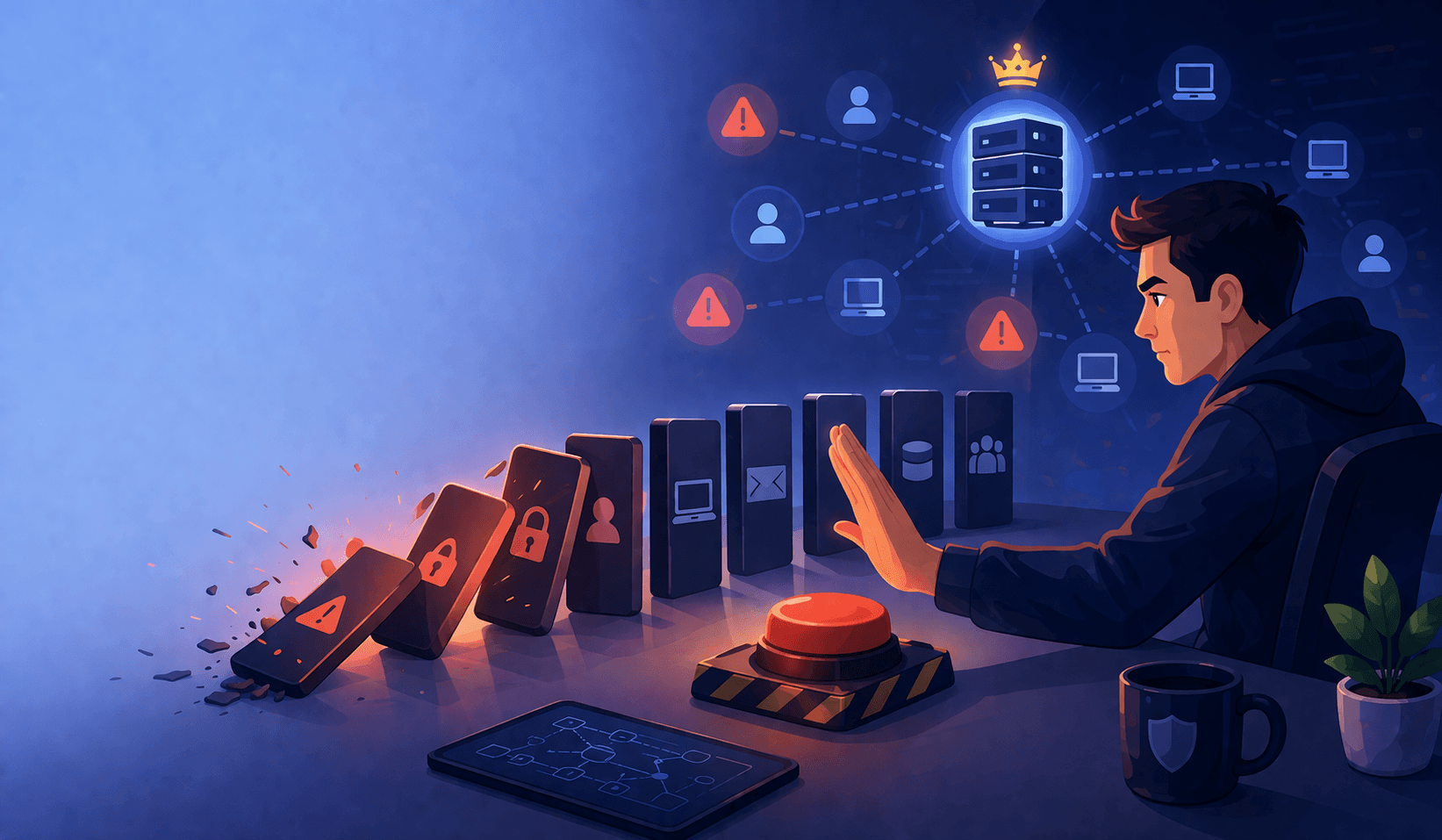
The first hour shapes everything that follows. Early mistakes in incident response tend to compound: evidence disappears, infrastructure breaks, leaders get surprised, and attackers keep moving while the team reacts to the wrong symptom. Strong responders create clarity faster than they create motion.
That is why interviewers care less about specific tooling than about sequencing. The durable skill is knowing what must be true before you act, what could be lost if you act too soon, and who needs to know while those questions are still open.
Red Flags
- Containment impulse. The candidate isolates or resets aggressively before understanding host role, scope, or evidentiary cost.
- Single-scenario thinking. One explanation is assumed without testing alternatives.
- No evidence plan. The answer never mentions volatile artifacts, timelines, or preservation trade-offs.
- No communication path. The responder appears to work alone until they feel confident.
- Infrastructure blindness. The operational consequences of acting on a domain controller are ignored.
Key Takeaways
- The first symptom is rarely the whole story. Test multiple hypotheses before committing to a response direction.
- Fast containment can be the wrong action. Weigh evidentiary and operational impact before isolating critical infrastructure.
- A domain controller is not just another host. Response mistakes on critical authentication infrastructure can create a second outage on top of the first.
- Serious responders communicate early, not after they feel confident. Incident response depends on clean coordination under uncertainty, not solo investigation.