The Behavioral Questions That Actually Come Up in Security Interviews
Cybersecurity professionals often prepare thoroughly for technical questions and barely prepare for behavioral ones. That is a mistake. Behavioral interviews in security roles are not a formality. They test skills that matter more in security than in most other engineering disciplines: communicating risk to non-technical people, handling disagreement about priorities, and making decisions when something goes wrong.
Here are the questions that actually come up, what the interviewer is evaluating behind each one, and how to answer them well.
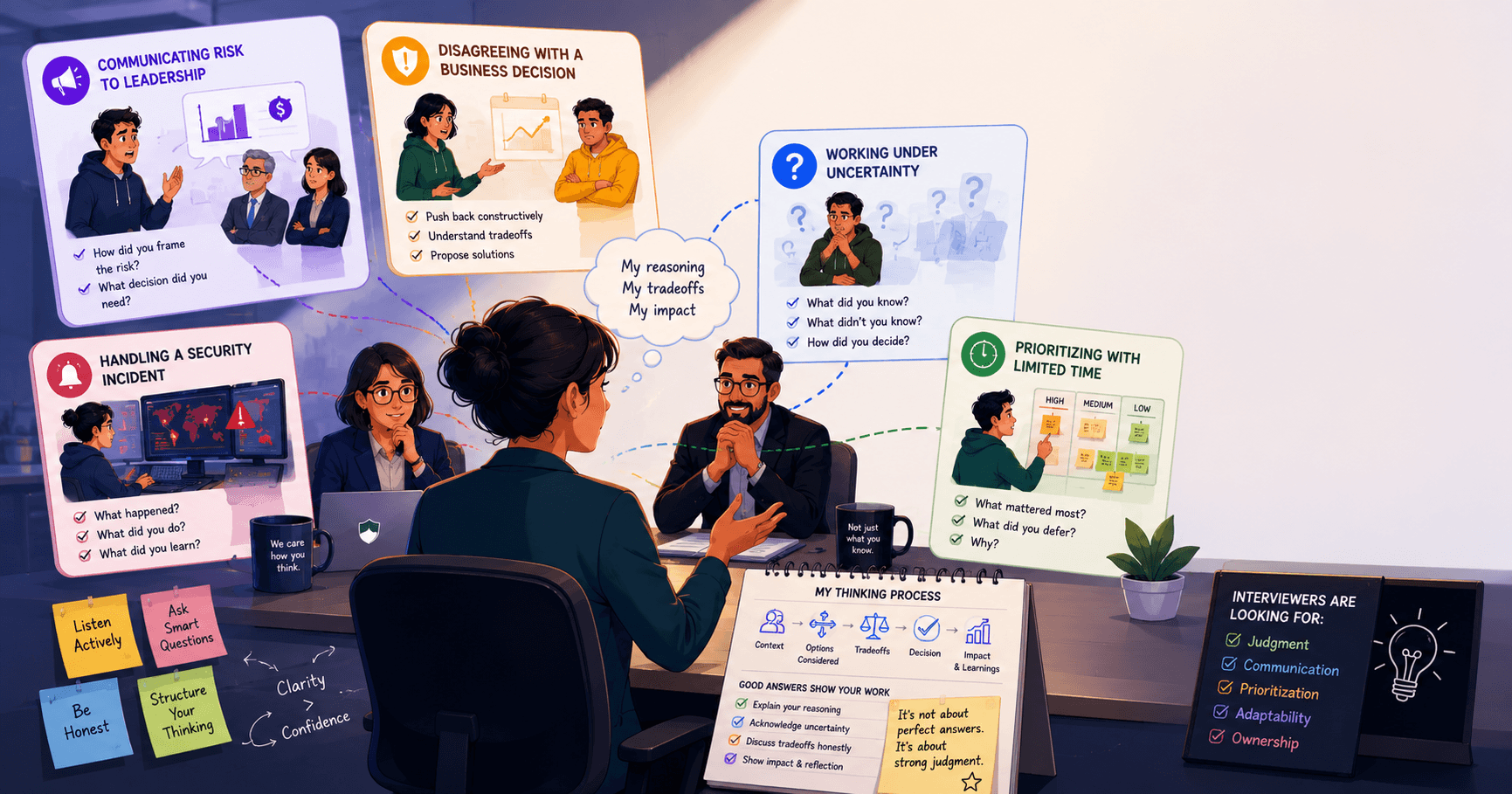
"Tell me about a time you communicated a security risk to non-technical leadership."
What they are really asking: Can you persuade someone to take action, not just translate jargon?
This question has a trap. Candidates describe the technical content of what they communicated without describing how they made it land. Leadership communication in security is a persuasion problem, not a translation problem. You are trying to get someone to approve a budget, accept a risk, or change a priority.
A strong approach: Describe how you framed the risk in business terms. Not "we have a critical CVE" but "if this is exploited, here is the business impact." Explain what you specifically asked for and how you handled pushback. Include cases where leadership accepted the risk and you disagreed, because that happens and pretending it does not is unconvincing.
"Tell me about a time you disagreed with a business decision on security grounds."
What they are really asking: Can you push back without being obstructionist? Do you know when to escalate versus when to accept?
A weak answer describes a conflict where you raised a concern and everyone immediately agreed. That is not disagreement. The question is testing how you handle genuine conflict.
A strong approach: Be specific about the risk. A candidate I interviewed once described a situation where the product team wanted to ship a payment integration before security review was complete. Instead of blocking the launch entirely, she asked for a 48-hour delay to test the highest-risk component: webhook signature validation. When the VP pushed back on timing, she negotiated enhanced logging and a manual review process as compensating controls, with a commitment to complete testing within five days post-launch.
That answer shows negotiation, risk prioritization, and documentation instincts. It also includes what she would do differently: flag the testing gap earlier in the timeline.
"Tell me about a significant security incident you were involved in."
What they are really asking: Can you learn from failure without being defensive?
Security teams that cannot do honest post-incident analysis repeat the same mistakes. Interviewers want to see analytical engagement with something that went wrong, not just a narrative where everything worked out.
A strong approach: Describe what you knew and when. Include the decisions that in hindsight were wrong and why they made sense at the time. Explain what specifically changed afterward. The best answers acknowledge uncertainty: "I was not sure whether to contain immediately or preserve evidence first, and that ten-minute decision window felt very long." That level of honesty signals real experience. It is the same triage thinking that IR interviews test, but framed around your personal decision-making.
"Tell me about a time you worked under uncertainty."
What they are really asking: Do you freeze, guess, or make defensible decisions with incomplete data?
Security work is full of incomplete information. Interviewers want to see a structured approach: here is what I knew, here is what I assumed and why, here is the decision I made, here is what I would change.
A strong approach: Pick a scenario where the uncertainty was genuine and consequential. Describe the options you considered, the factors that drove your decision, and whether it turned out to be right. If it was wrong, explain what you learned.
Making your reasoning visible
Across all these questions, the differentiator is the same: strong candidates make their reasoning transparent. Most people can describe situations, tasks, actions, and results adequately. Very few explain why they made the decisions they made, what alternatives they rejected, and what they would do differently.
The STAR framework (Situation, Task, Action, Result) works, but add a Reasoning layer between Task and Action. What was your analysis of the problem? What options did you weigh? That is where you stand out.
Preparation that works
Before any interview, prepare three to five stories covering: communicating risk upward, disagreeing with a business decision, handling an incident or failure, working under uncertainty, and prioritizing competing security concerns. Practice making your reasoning explicit out loud, because thinking through an answer silently is a different skill than saying it clearly.
If your stories feel generic, they probably are. The specificity test: could someone at a different company, in a different industry, tell the same story? If yes, add more detail. Interviewers can tell the difference, and these are among the most common red flags across all cybersecurity interviews.
Behavioral questions catch people off guard because they seem easy. MyKareer's behavioral set is cybersecurity-specific. Try a few.