Privacy Interviews Test Design Instincts, Not GDPR Recall
In January 2022, the Austrian data protection authority ruled that a company's use of Google Analytics violated GDPR because it transferred EU user data to the United States without adequate safeguards. The fine was modest. The consequence was not. It triggered a wave of enforcement actions across Europe and forced thousands of companies to rethink analytics implementations they had treated as routine for years.
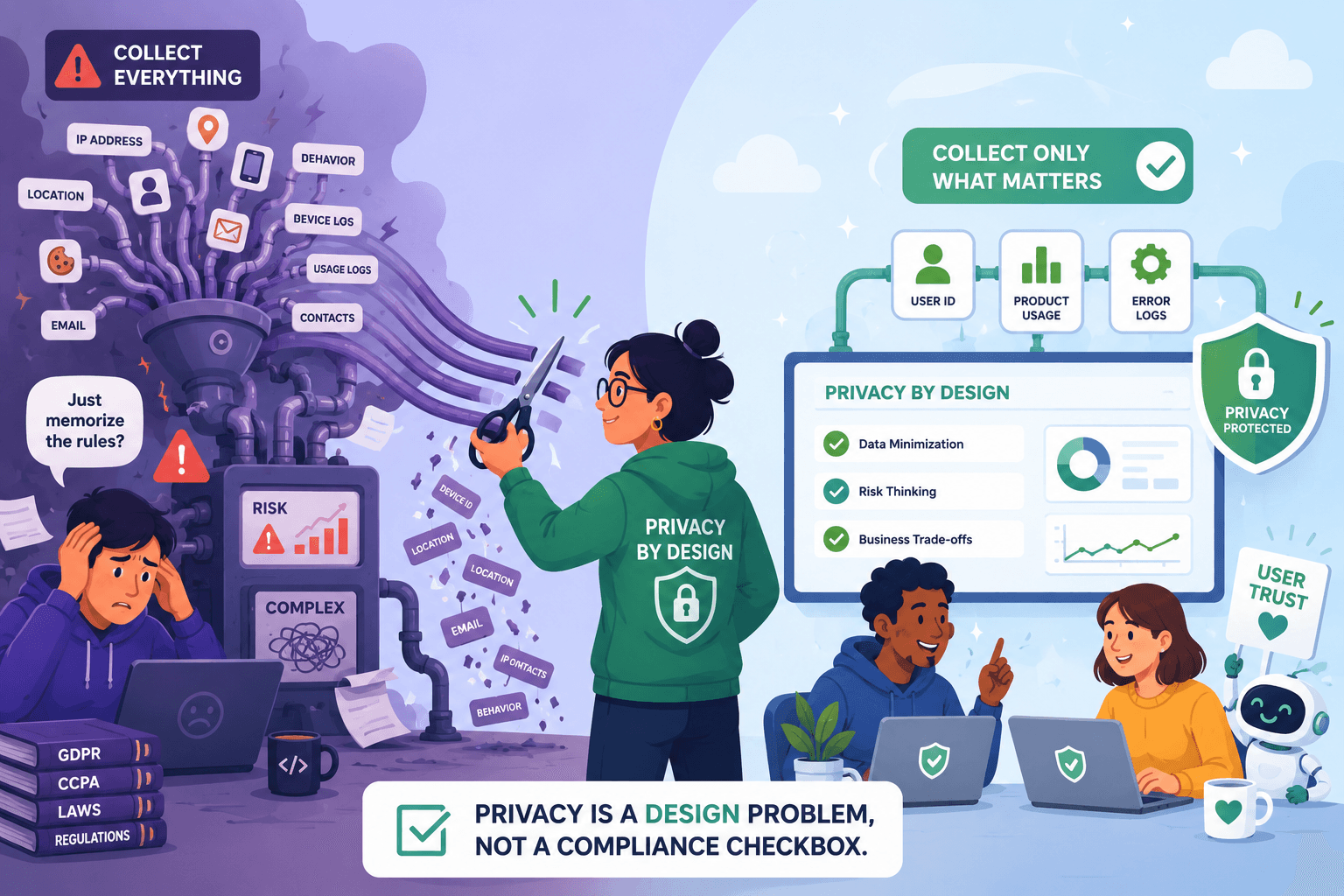
That case illustrates something privacy interviewers care about deeply: privacy is a design problem, not a compliance problem. The companies that scrambled were the ones that had checked the legal box without thinking about data flows. The ones that had already minimized data collection and kept analytics server-side barely noticed.
If you are preparing for privacy interviews, the most important thing to internalize is that interviewers are evaluating your design instincts, not your ability to recite GDPR articles. Almost every privacy interview question boils down to three core questions.
Question one: what data is actually necessary?
This is the data minimization question, and it comes up in nearly every privacy interview, sometimes directly, sometimes embedded in a scenario. A product team wants to add behavioral analytics. An engineering team wants to log every API call. A marketing team wants to integrate a third-party tracking pixel.
In each case, the interviewer wants to hear you ask: what problem are we trying to solve, and what is the minimum data required to solve it?
A candidate who immediately jumps to "we need consent" or "we need to check GDPR applicability" has skipped the most important step. Before any regulatory analysis, a privacy professional should understand the purpose and evaluate whether the proposed data collection is proportionate to it.
For example, if a product team wants to understand why users drop off during onboarding, they probably need aggregate funnel metrics, not individual session recordings with keystrokes and location data. That distinction is a design decision, not a legal one. The legal analysis follows from it.
This connects directly to how application security teams think about data handling. The less sensitive data you collect, the smaller your attack surface if something goes wrong.
Question two: what happens when this goes wrong?
Privacy harm assessment is where many candidates stumble. They can identify that a processing activity involves personal data, but they have not practiced thinking through realistic harm scenarios.
I once interviewed a candidate who gave a technically perfect answer about lawful bases for processing but could not articulate what would actually happen to users if the data they described collecting was exposed in a breach. That gap matters. Regulatory compliance and privacy harm are related but not identical. A processing activity can be technically lawful and still create real harm: unexpected inferences about health conditions from fitness data, location patterns that reveal sensitive information about someone's life, or behavioral profiles that enable manipulation.
Strong candidates think about harm concretely. They consider who could access the data (first parties, third-party SDKs, analytics vendors), what inferences could be drawn from it, and what the realistic consequences of exposure would be. This kind of risk thinking overlaps significantly with how GRC professionals approach risk assessment.
Question three: what is the less invasive alternative?
This is the privacy-by-design question, and it is where the best candidates distinguish themselves. After understanding the purpose and assessing the risk, the question becomes: can we achieve the same goal with less data, less retention, or less access?
Concrete examples of privacy-by-design decisions that interviewers love to hear about:
Aggregate instead of individual. If the business question can be answered with counts and percentages, there is no reason to store individual-level behavioral data.
On-device computation. For some analytics, you can derive the insight locally on the user's device and send only the result, never the raw behavior. Apple's approach to keyboard predictions is a well-known example.
Sampling instead of exhaustive collection. Analyzing 10% of sessions often answers the same product question as analyzing 100%, with dramatically lower privacy exposure.
Purpose-matched retention. Analytics data needed to evaluate a feature launch does not need to live forever. Setting aggressive retention limits (maybe 30 days for detailed logs) reduces exposure without sacrificing the business purpose.
Tiered access. Not everyone who needs aggregate dashboards needs access to raw user-level data. Access controls that match the access to the purpose reduce the risk surface.
These are the kinds of decisions that privacy teams at mature organizations make every day. They turn privacy from a veto function ("legal says no") into a collaborative design exercise ("here is how we can achieve your goal with less risk").
A real scenario, walked through
Here is what a strong privacy interview answer looks like in practice. The question: "Your engineering team wants to log every API call, including parameters, to help with debugging. How do you evaluate this?"
A strong candidate does not start with GDPR. They start with: "What debugging problems is this actually solving?" Because if the goal is diagnosing user-reported errors, you probably need error states and context around them, not a log of every successful call. Full parameter logging almost certainly captures personal data (user IDs, search queries, content the user typed), which creates real exposure if those logs are broadly accessible or retained indefinitely.
From there, the candidate proposes a tiered design: minimal logging in normal operation (timestamps, endpoints, error codes, anonymized identifiers), detailed parameter logging only for opt-in debug sessions or short sampling windows with 30-day retention, and restricted access to full logs. The regulatory analysis comes last, framed around proportionality: can we demonstrate that we could not achieve the debugging goal with less data?
That is privacy-by-design thinking. It is what the interview is actually testing.
The red flags that sink candidates
Having been on both sides of privacy interviews, a few patterns consistently concern hiring managers:
Treating consent as a universal solution. "Just get consent" is the most common weak answer in privacy interviews. Consent is one lawful basis among several, and for many processing activities (employee monitoring, fraud detection, system security) it is not the appropriate one.
Not engaging with the business purpose. Privacy professionals who cannot have a practical conversation about what the business is trying to achieve get bypassed by product teams. If you evaluate features in isolation from their purpose, you miss the proportionality analysis entirely.
Forgetting third parties. Many privacy problems come from data flowing to third-party tools, SDKs, and analytics platforms, not from first-party collection. The Austrian Google Analytics case is a perfect example. Ignoring the third-party data flow surface misses a large part of the problem.
Skipping the harm assessment. If your analysis stops at "this is lawful" without considering "but what happens when it goes wrong," you are leaving out the part that matters most when building a career in this space.
Privacy interview questions on MyKareer test design thinking, not regulation recall. Practice free.