What a Purple Team Engagement Actually Looks Like, Day by Day
Most people think purple teaming is just red team and blue team in the same room. That description is technically accurate the way "cooking is just applying heat to food" is technically accurate. It misses everything that makes it work.
In interviews, this misconception produces answers that describe a format ("red team attacks, blue team detects, then we debrief") without explaining the decisions that make the format produce results. Interviewers who have run purple team programs hear this constantly, and it tells them the candidate has read about purple teaming but has not done it.
Let me walk through what a purple team engagement actually looks like, day by day, and what interviewers want to hear about each phase.
Two weeks before: scoping around gaps, not scenarios
A purple team exercise starts well before anyone runs a technique. The first step is understanding where your detection coverage actually stands.
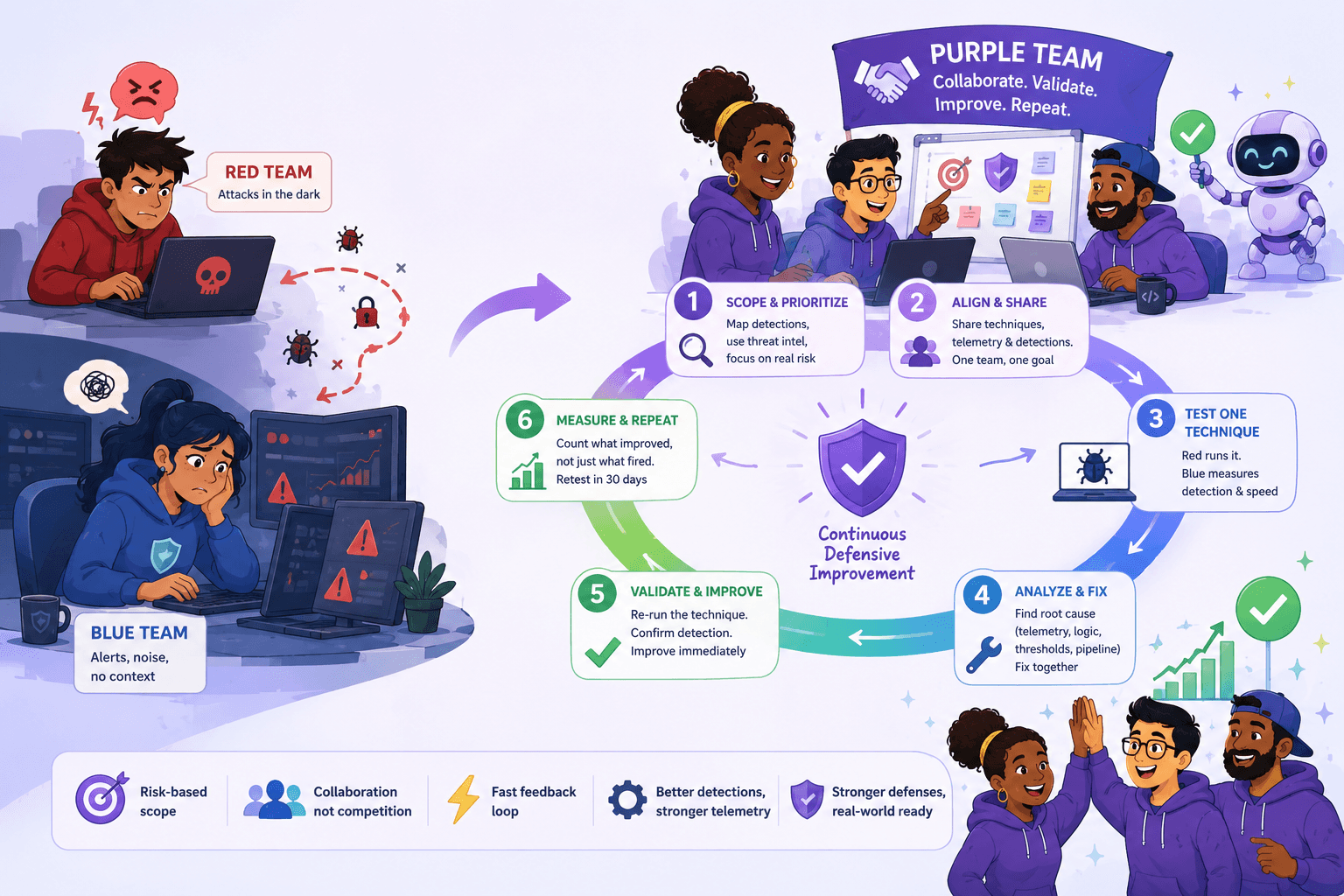
This means pulling your existing detections and mapping them against a framework like ATT&CK. You are looking for three categories: techniques you have validated detections for, techniques where you have telemetry but no detection logic, and techniques where you have no visibility at all. That third category is where you focus.
The key decision here, and the one interviewers probe, is how you prioritize which gaps to target. Not all gaps are equal. You cross-reference against threat intelligence: which techniques are commonly used by adversaries relevant to your industry? Which would represent meaningful attacker progress in your specific environment? A detection gap for a technique no one uses against your sector is lower priority than a gap in lateral movement detection when your threat profile includes APT groups that rely on it.
I have seen candidates describe selecting techniques by walking through ATT&CK top to bottom. That approach is methodical but not strategic. It is busy work dressed up as a methodology. Interviewers want to hear that your technique selection is driven by risk, informed by threat intelligence analysis.
Day one: setting the table
The exercise begins with alignment, not attacks. Red team and blue team sit down together (this part is non-negotiable) and review what will be tested and why.
Red team shares the specific execution procedures for each technique. This is not a red team assessment where operational security matters. The whole point is transparency. Blue team shares what telemetry they have for those techniques and what detections currently exist, if any.
This is where a lot of candidates lose interviewers. They describe setups where the red team "tries to evade" blue team's detections. That is an adversarial framing, and it defeats the purpose. Purple team requires sharing TTPs, execution details, and tooling openly so the focus stays on improving detection, not on maintaining operational security.
Days two through four: the iterative loop
Here is where the actual work happens, and where the methodology diverges most sharply from a red team assessment.
Red team executes a single technique. Blue team checks: did the detection fire? What did it fire on? What was the latency between execution and alert? Was the signal high enough confidence to act on?
Then, and this is the critical part, you pause. If the detection fired correctly, you document it as validated and move on. If it did not fire, you do not just note it as a gap and keep going. You debug it together, right there.
The debugging is where the real value lives. Maybe the detection did not fire because the log source is not being collected. Maybe the query does not match the actual event structure the technique produces. Maybe the threshold is set too high. Maybe the telemetry exists but is not being forwarded to the SIEM. Each of these root causes requires a different fix, and identifying which one applies requires both the attacker's understanding of what the technique produces and the defender's understanding of the detection pipeline.
You fix it, re-run the technique to verify the new or updated detection works, and then move to the next technique. One technique at a time. Immediate feedback loops.
If you batch everything and debrief at the end, you have run a red team assessment that blue team watched. The iterative improvement during the exercise is what distinguishes purple team methodology. I once worked with a team that insisted on running all techniques first and "doing detections later." They ended up with a 40-page findings report and zero new detections. That is an expensive way to confirm what you already suspected.
Day five: measuring what changed
The deliverable from a purple team exercise is not a findings report. It is a revised detection coverage map showing what improved.
For each technique tested, you document: initial detection status, what was found during testing, what was changed, and the re-validation result. Success is not measured by detection rate (that just tells you where you started). Success is measured by how many new or improved detections were validated during the exercise.
You also document data source requirements that surfaced during testing. Maybe you discovered that endpoint telemetry that SOC analysts depend on was not being collected from certain host segments. That is an infrastructure finding, not a detection finding, and it goes into a separate remediation track.
Strong candidates also build in a re-test cycle, coming back 30 days later to run the same technique set against the updated detections. Detections that worked during the exercise sometimes break when the environment changes, rule updates get reverted, or log sources shift. The follow-up validates that the improvements held.
What interviewers are really asking about
When an interviewer asks "How would you design a purple team exercise?", they are testing several things at once.
Can you design for collaboration? The value of purple team is not that you test more techniques. It is that the people who understand attacker behavior and the people who understand detection logic are making real-time decisions together. That only works with explicit pause points, joint debugging sessions, and shared ownership of outcomes. Exercises designed entirely by red team without blue team input on what they can actually detect with existing telemetry miss this.
Do you understand the difference between testing posture and changing posture? Red team exercises test your current defenses. Purple team exercises change them. This frame shift, from assessment to improvement, is the core concept. Candidates who describe purple team as "a more collaborative red team engagement" have not made this shift.
Can you connect technique selection to threat intelligence? Running through generic ATT&CK techniques without considering what is actually relevant to your environment is a red flag. The technique set should reflect the adversaries and methods your organization realistically faces, not a generic matrix walk.
The red flags that cost candidates
No feedback loop during execution. If detection fixes only happen in a post-exercise debrief, you are describing a red team assessment with a blue team audience.
Measuring success by detection rate. A 60% detection rate at the end of an exercise tells you what your coverage was before you started. The meaningful metric is: how many detections were created or improved?
Treating red and blue as adversaries. Some candidates describe setups where the red team tries to be stealthy. That framing optimizes for realism at the expense of improvement. Purple team optimizes for improvement.
No consideration of telemetry requirements. Detection improvements are only possible if the underlying log sources exist. Strong candidates treat data collection gaps as a first-class output of the exercise, not an afterthought.
Designing without a threat model. Technique selection should be risk-driven. Candidates who pick techniques because they are "interesting" or "common" without linking them to relevant threats are missing the strategic layer.
Purple team questions on MyKareer test whether you can bridge offense and defense. See the questions.