How to Run a Senior Cybersecurity Interview, Not Just Survive It
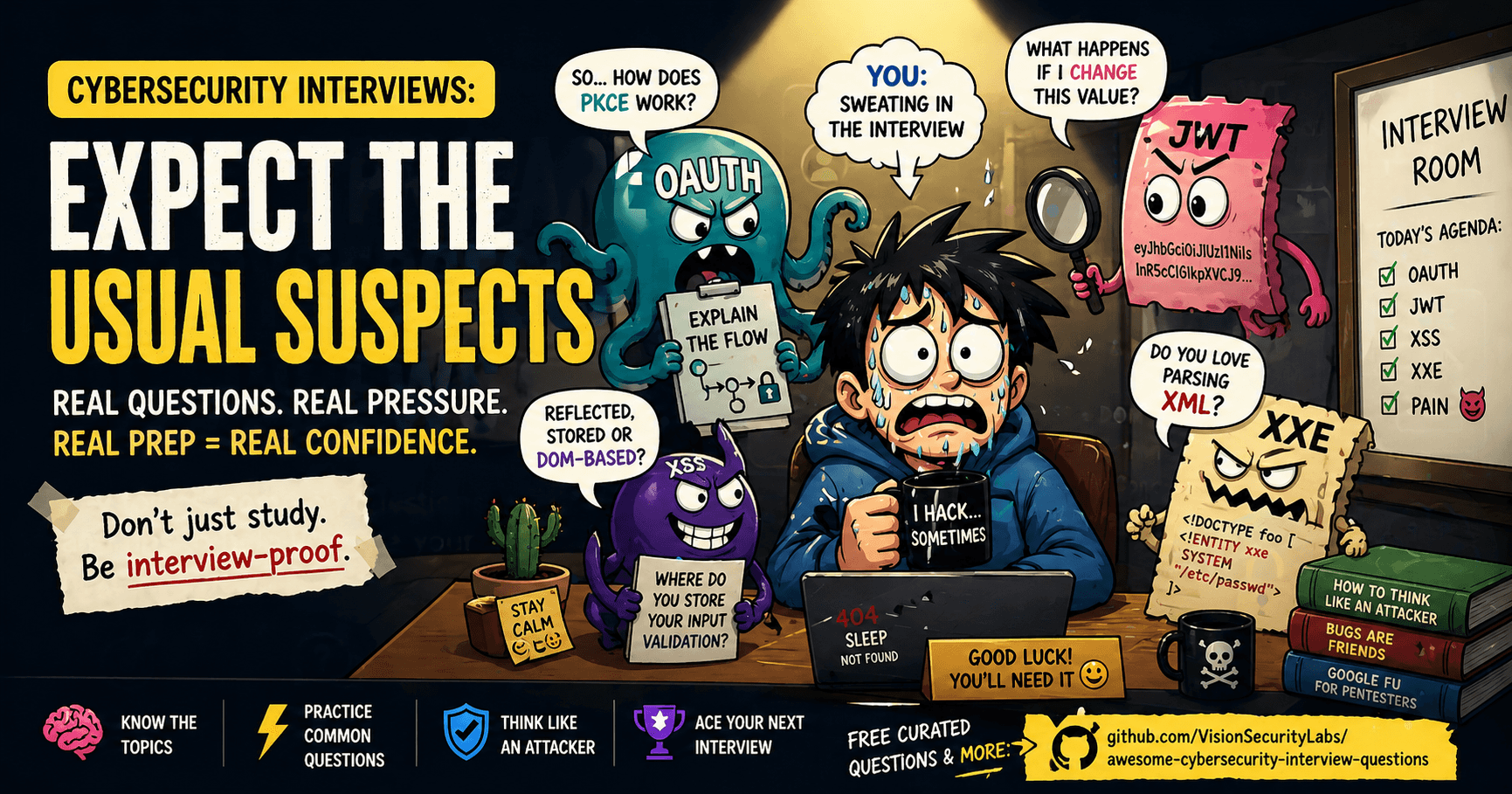
Most cybersecurity professionals prepare for the wrong interview. They memorize CVE timelines, rehearse threat models, and build mental Anki decks on MITRE ATT&CK techniques. Then they sit down with a hiring manager, dump everything they know in the first 15 minutes, and spend the next 45 minutes getting grilled on whatever weak spots the interviewer decides to probe.
That is not preparation. That is handing conversational control to someone whose job is to find your limits.
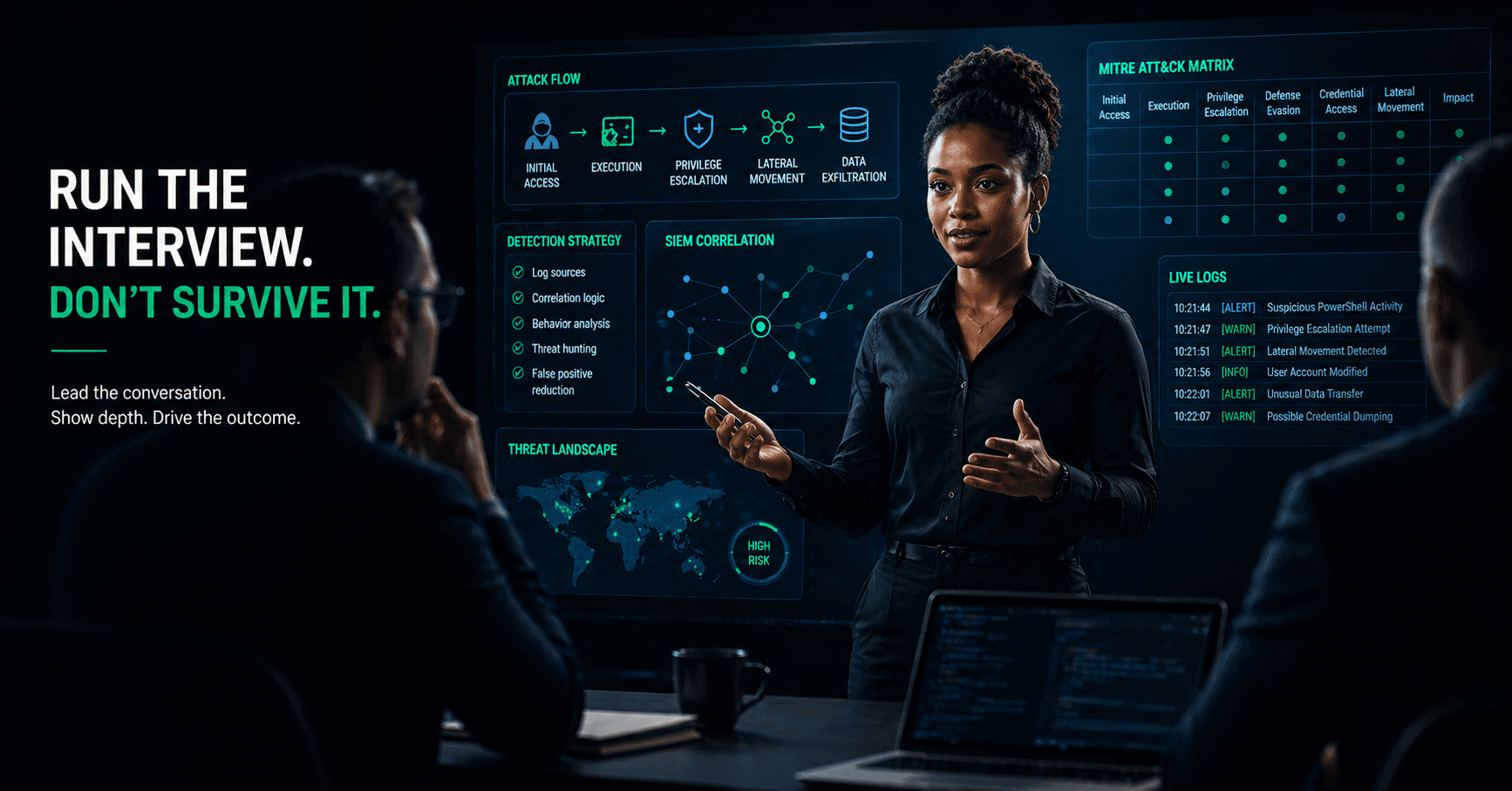
A transcript analysis of a senior technical interview reveals a cleaner model: the candidate who gets the offer is not always the one with the deepest knowledge. It is the one who controls pace, plants technical hooks, and signals production-grade seniority through vocabulary and structure, not through recall speed. This post breaks down each mechanism with patterns you can use directly.
The Core Diagnosis
The default failure mode of technically strong candidates is going too fast. You cover your material in 15 minutes, then sit in open Q&A where the interviewer drives. In a security interview, that means getting pushed into edge cases, obscure protocol specifics, or hypotheticals designed to find the floor of your knowledge.
The senior move is the inverse: deliver less, but with more hooks. Pace yourself so the interviewer is navigating your map, not exploring the codebase of your knowledge unsupervised.
Three mechanisms make this work:
- Pace control: you run the clock; the interviewer asks permission to redirect
- Domain hygiene vocabulary: you speak fluently in the language of production security discipline
- Technical hooks: you plant novel-sounding decisions in passing, controlling where the deep dives go
Mechanism 1: Announce Structure Before Delivering Content
Before any substantive answer, state the shape of your response. This signals "I have a plan" and makes interruptions feel premature.
Patterns:
- "There are two parts to that question, I will take them in order."
- "Let me start with the architecture choice, then the detection logic, then what we learned in production."
- "Quick high-level first, then we can drill down where useful."
In a security context, this applies directly to incident response walk-throughs, architecture explanations, and threat model descriptions. When asked "how would you handle a ransomware incident," the wrong move is to launch immediately into your first action. The senior move:
"I would approach this in three phases: initial scoping to understand blast radius, containment sequencing to prioritize business-critical systems, and forensic preservation to not compromise the evidence chain. Let me go through each."
The interviewer now knows you have a complete framework. They are more likely to wait for you to finish a section before redirecting.
Mechanism 2: Defer Depth Explicitly
Junior candidates dump everything they know on every question because silence feels like ignorance. Senior candidates understand that control is more impressive than completeness.
When you mention a technical decision, you do not have to explain it immediately. Name it, flag it as something you can return to, and keep the thread.
Patterns:
- "Quick mention here: happy to go deep on this if useful, but for now let me keep the thread."
- "There is a longer story on the detection logic, I will park it and continue."
- "That is worth its own conversation, let me note it and move on."
In security interviews, this matters because the field is wide. You might reference log aggregation architecture, EDR tuning methodology, threat intel enrichment pipelines, and purple team exercise design all within a single role description. You cannot go deep on all of them in 60 minutes. Naming depth and deferring it explicitly signals you have it, without spending your time budget on it prematurely.
Mechanism 3: End Sections With a Structured Choice, Not an Open Question
The weakest close to any answer is "any questions?" It hands full conversational control to the interviewer with no constraints. The stronger move: offer two paths and let them choose. Either they pick one you have prepared (you stay in control) or they redirect to their own interest (you still framed the territory).
Patterns:
- "...that is the detection architecture. Want me to go deeper on the SIEM correlation logic, or move to the response playbook?"
- "...that is the threat model. Where would be most useful to dig, the data flow assumptions or the trust boundary decisions?"
- "...does that align with the threat profile you are seeing in this environment?"
The last pattern is particularly effective in security: it signals you are evaluating fit, not just performing. Senior security professionals choose their environments. The interview should demonstrate that framing on both sides.
The Hook Technique: Planting Technical Curiosity
This is the highest-leverage move and the one most candidates skip entirely.
A hook is a technically interesting decision mentioned in passing, not explained, while you are talking about something else. It works because of three simultaneous effects in the interviewer's cognition:
- Curiosity gap: the brain resists unfinished technical threads, especially ones that sound non-obvious
- Implicit depth signal: mentioning something complex casually implies "this is not even my headline material"
- Frame shift: once they ask "tell me more about that," you have moved from being evaluated on their checklist to being asked to teach. That is a fundamentally different power dynamic.
Hook Construction Template
For each significant project or incident in the last three years, write:
- Mundane framing: what most candidates would say
- Hook framing: one sentence, planted in passing, with a non-obvious decision implied
- 90-second deep dive: what you say if they bite (the actual trade-off, the alternative rejected and why)
Finding Your Hooks
Take any project you would describe with a mundane one-liner. Then ask yourself these questions about it. The answers are your hooks.
"We tuned our SIEM alert thresholds."
- What drove the decision to tune: noise volume, a missed detection, a failed audit?
- What trade-off did you accept, and why was it the right call at the time?
- Which alert class was the hardest to get right, and what made it difficult?
- Did tuning surface a detection gap you had not expected?
- What would you do differently with more time or better data?
"We ran a tabletop exercise."
- What scenario did you choose and why that one over others?
- Where did the team's assumptions break down?
- What changed in your playbooks or escalation paths afterward?
- Was there a decision point that exposed a gap between policy and what people actually do under pressure?
"We built an IOC enrichment pipeline."
- What data sources did you include, what did you leave out, and why?
- What was the latency between indicator publication and operationalization?
- Where did the pipeline produce false confidence rather than useful signal?
- What broke first in production and how did you fix it?
"We implemented SAST in CI."
- What was the false-positive rate and how did you handle developer friction?
- Did you block on findings or report only, and what happened when you tried the other approach?
- Which finding class produced the most debate with engineering?
- How did you measure whether the integration actually reduced risk?
"We audited our AWS IAM posture."
- What was the most surprising thing you found that was not an overprivileged role?
- How did you prioritize remediation across findings?
- What did you leave in place, and what was the accepted risk reasoning?
- How long had the worst finding been there, and how did it accumulate?
Build eight to twelve of these from your own work. One question with a specific, honest answer is worth more than five polished sentences you rehearsed. You will not use them all in any one interview. Land two or three and the interviewer's curiosity does the rest.
How a Hook Should Feel When Delivered
- Sub-15 seconds total
- Mentioned in service of a different point, not as the headline
- Contains one concrete technical noun the interviewer can grab onto (correlation rule, trust boundary, suppression logic, cold-start problem)
- Implies a non-obvious decision was made
- Followed by your continuation, without pausing to invite a question
The pause and the invitation are the interviewer's choice to make, not yours.
Domain Hygiene Vocabulary: What Reads as Senior in Security
Even when two candidates have equivalent hands-on experience, one often reads as significantly more senior. The differentiator is fluency with production security discipline vocabulary: the language of someone who ships and operates security controls in real environments, under real constraints.
The vocabulary that signals production credibility in security roles:
Detection and response:
- Detection coverage framed against ATT&CK tactics, with honest gaps named: "we have solid coverage on execution and persistence, weaker on lateral movement"
- Talking about alert quality in measurable terms: volume, noise rate, how long triage takes, what you suppressed and why
- Playbook versioning and exception handling procedures
- Cross-team escalation thresholds and documented decision authorities
Architecture and engineering:
- Defense-in-depth with explicit trust boundary documentation
- Logging strategy: what you collect, what you drop, retention tiers and why
- Separation between security tooling and business system dependencies (blast radius thinking)
- Security infrastructure managed as code, whatever tooling the org uses, so changes are auditable and repeatable
Operational maturity:
- Red and blue team findings feeding the same detection backlog, not living in separate reports
- Threat model review tied to architecture change, not just annual compliance cycles
- Metric-driven program reporting: not "we are secure" but "here is our current coverage gap and detection latency"
The goal is not to pepper the interviewer with terminology. It is to use these terms naturally, precisely, and in context, the way someone who has actually operated these systems would use them.
The 60-Minute Interview Map
A typical senior security interview should be structured like this, from the candidate's perspective:
| Phase | Duration | Who drives | |---|---|---| | Clarifying questions about the role and context | 3-5 min | You | | Your structured pitch: background, domain focus, 3-4 hooks | 8-10 min | You | | Guided deep dives on hooks you planted | 30-35 min | You partially steer | | Your questions to them | 5-10 min | You | | Wrap and next steps | 5 min | Mutual |
The most common mistake: trying to deliver in 10 minutes what should take 30-35 minutes of guided conversation. The solution is to plant five to six hooks in the pitch without explaining any of them. The interviewer now has 30 minutes of material to choose from, all on territory you have prepared.
Asking clarifying questions upfront is not stalling. It is a strong seniority signal. It demonstrates that you evaluate fit, not just performance. And it gives you intelligence to tailor which hooks you lead with.
Handling the Weak-Spot Question
Every senior security interview includes at least one question designed to probe a gap: a technology you have not worked with, a domain where your experience is thin, or a scenario that falls outside your direct background.
The wrong response: defensive hedging, padding, or pivoting away without acknowledging the gap.
The senior response: own the gap, frame it as a current boundary with a learning direction, and pivot to a related strength where your judgment still applies.
Pattern:
"I have not worked directly with [X]. My hands-on has been with [Y], which has comparable challenges around [specific shared problem]. Where I would apply judgment on [X] is [reasoning]. That said, I would want to go deeper before speaking to the specifics, and here is how I would approach getting there quickly."
This does three things simultaneously: it is honest, it demonstrates transferable reasoning, and it signals self-awareness about how to close gaps systematically, which is what you want in a senior security hire.
Before Every Interview: A 10-Minute Checklist
24 hours before:
- Review your hook inventory for this specific role and sector
- Select the five or six hooks most relevant to their stack and threat profile
- Read the role description for explicit signals about what they value: detection engineering vs. architecture, compliance vs. offensive, cloud-native vs. hybrid
- Check the interviewer's background: former practitioner or manager shapes which hooks land
30 minutes before:
- Do one spoken run of your two-minute background out loud, standing
- Note the three hedging patterns you are eliminating this week (the verbal tics that leak uncertainty: "I think maybe," "something like," "I am not sure but")
- Set the frame: "I am running this conversation. They are choosing where to dig."
Opening two minutes:
- Ask two or three clarifying questions about the role before pitching yourself
- "What does the threat profile look like in your environment?" signals both curiosity and domain orientation
- Then: "Let me give you a quick high-level, then go deeper where most useful."
Key Takeaways
- When asked any multi-part question, announce the structure before delivering content: the interviewer enters a waiting posture before you have said anything substantive
- When you mention a technical decision in passing, do not explain it immediately: name it, flag it as available depth, and keep your thread
- When closing any answer, offer two specific paths rather than "any questions?": either way, the next topic is one you have prepared
- When you have a knowledge gap, own it precisely and pivot to transferable reasoning: honesty paired with judgment is more credible than performance
- Build eight to twelve technical hooks from your real work before any interview cycle: two or three well-placed hooks consistently outperform exhaustive recall
Security interviews test methodology and judgment, not memorization.
Practice what that actually sounds like. MyKareer's behavioral and technical sets are designed to help you develop the reasoning out loud, not just the knowledge.