Certs Open Doors. They Do Not Pass Interviews.
Certs open doors. They do not pass interviews. I have watched candidates with impressive certification lists stumble through basic methodology questions, and I have watched candidates with no certs beyond Security+ deliver answers that made hiring panels nod. The cert is a signal. What you can actually do in the room is the test.
That said, not all certs are equal. Here is an honest assessment.
The certs that carry real weight
The certifications that impress hiring managers share one characteristic: they are hard to fake because they require demonstrating skills under pressure.
OSCP has the strongest reputation in penetration testing. The exam requires compromising real machines over 24 hours with no multiple-choice questions. You either get the flags or you do not. Interviewers in offensive security use OSCP as a meaningful signal because they know what the exam involves. If you are transitioning from SOC to pentesting, OSCP is the cert that addresses the most obvious concern about your background.
CISSP carries weight for different reasons. It covers security management, architecture, risk, and governance across eight domains. It is broad, not deep, and interviewers understand that. Where CISSP matters most is in senior and leadership roles where contextualizing security across business, legal, and technical dimensions is the actual job. The five-year experience requirement means holders have demonstrated career tenure, not just exam performance.
GIAC certifications (GPEN, GCIH, GREM, GCFE) are expensive but respected because they pair practical labs with deeper-than-average exams. GREM is well-regarded for malware analysis. GCIH for incident handling. Consulting firms and government contractors frequently use GIAC certs on shortlists.
Cloud security certs from AWS (Security Specialty), Azure (Security Engineer Associate), and GCP (Professional Cloud Security Engineer) carry real weight because the providers update exams frequently and the content maps directly to actual platforms.
The certs that help less than people expect
Security+ is valuable as a baseline and satisfies DoD 8570 requirements. The problem is that it is so widely held that it does not differentiate. Having it checks a box. Not having it removes you from some roles. It is a threshold requirement, not a strength signal.
CEH has a poor reputation among practitioners. The exam is multiple-choice and the content is considered superficial. Candidates who list CEH as their primary offensive credential face skepticism from interviewers who have seen that the cert does not correlate with hands-on ability. If you are choosing between CEH and OSCP, there is no comparison.
Vendor-specific certs outside of cloud platforms are resume noise unless the job explicitly requires them.
When certs matter and when they do not
Certs help most when changing career tracks. A SOC analyst with OSCP has a concrete signal of offensive investment. A developer with CISSP signals breadth beyond coding.
Certs help early career. When you lack professional experience, certifications partially compensate. A recent graduate with Security+, Network+, and home lab work is more compelling than one with neither.
Certs are required for compliance. Federal roles and DoD contracts require specific certifications regardless of demonstrated skill.
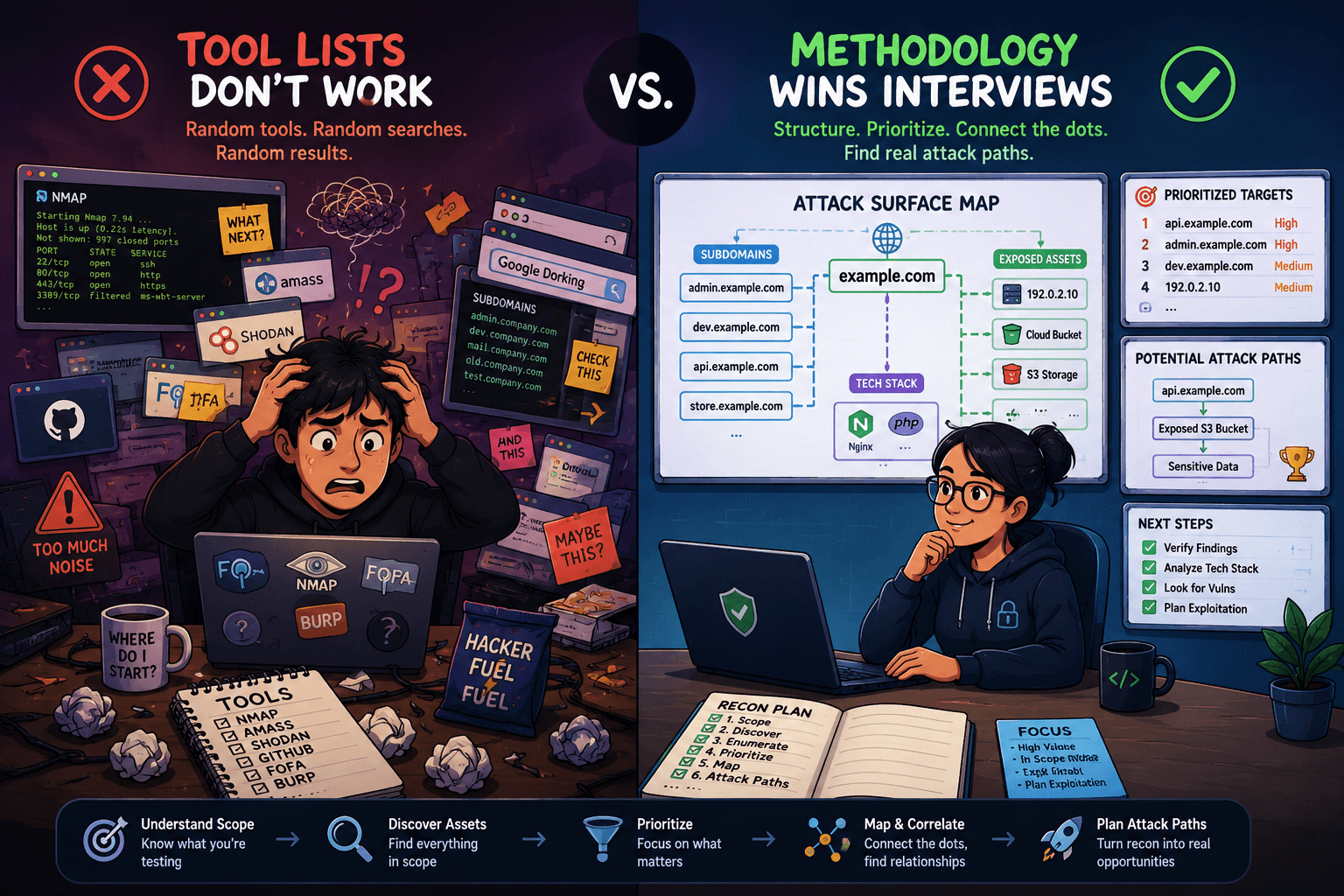
Certs do not compensate for weak methodology. A candidate with OSCP who cannot explain their investigation process in plain language will lose to a candidate without OSCP who walks through their reasoning clearly. The cert proves you studied. The interview proves you can perform.
How to talk about certs in interviews
The right approach is to explain what you learned and how you apply it:
Weak: "I have my OSCP, so I know penetration testing."
Stronger: "Working through PEN-200 forced me to build a systematic methodology for external and internal assessments. I got specifically stronger at AD attack paths and pivoting from network access to domain compromise. The report-writing requirement gave me a structure I still use."
The certification is context. The learning is the point. If you failed before passing, mentioning it is usually fine. It shows persistence and self-awareness.
A reasonable cert path by career track
SOC / IR: Security+ as baseline, then GCIH or GCFE for forensics. Cloud certs if the environment is cloud-heavy.
Pentesting: eJPT or PNPT as practical milestones, then OSCP as the primary goal. GPEN if your firm values GIAC specifically.
GRC / management: CISSP once you have the experience requirement. CISA or CRISC for audit or risk management work. See the GRC interview guide for what these roles actually test.
Malware analysis / threat intel: GREM for malware analysis. No single cert dominates threat intel, but the FOR610 course is considered the best structured path.
Cloud security: AWS Security Specialty or Azure Security Engineer depending on environment. Genuinely difficult exams. See the cloud security interview guide for what to expect.
The pattern across all tracks: prioritize certifications that require demonstrating skills, not recalling them.
Certs prove you studied. Interview practice proves you can perform. Practice free on MyKareer.